








Urocca Guyton was 13 years old the first time he was charged with a crime.
The kid who would become a notorious Denver gang member — who would father nearly two dozen children including three sons who would cut a path of destruction across the city years after their father was slain — first went to court for possessing marijuana. Then, for petty theft at 15, stealing a car at 16, assaulting a police officer at 17, aggravated robbery at 19, assault with a deadly weapon at 25.
And for murder at 27.
Prosecutors accused Guyton of participating in a shooting in which members of his gang killed a Sudanese refugee, a man returning home from work whom they mistook for a rival gang leader. Jurors found Guyton not guilty of that murder in 2015. Three years later, he was shot and killed outside an after-hours nightclub on Leetsdale Drive at age 31.
His children are now coming of age. During the past six years, three of Guyton’s teenage sons have been charged with murder in separate killings across metro Denver. Each homicide claimed the life of an innocent bystander.
Remi Cordova killed Pamela Cabriales when he was 14, wielding an AR-15-style rifle after a fender-bender on Colfax Avenue in 2021. Johntae Guyton killed Ramon Castro Contreras during an attempted robbery in Lakewood in 2022, when he was 17. And a third son is charged with the murder of Ja’Loynie Cosey, a 13-year-old boy who was shot to death outside a house party in Denver in 2025. The Denver Post is not identifying the third son, who was 14 at the time of the killing, because he is charged as a juvenile and has not been convicted.
But before Urocca Guyton’s sons were murder suspects, they were boys on the brink, kids growing up in the shadow of their father’s death and reputation, teetering between a bright future and devastation. The 8-year-old who crashed his mother’s car while she was home drunk. The boy known everywhere as his father’s son. The 6-year-old who shoplifted food and clothing for his younger siblings.
Each son slipped into ruin down his own path — one lured by the promise of easy money, another in the wake of years-long childhood abuse, a third after his brother was killed and mother jailed. Still, the family’s story over the last 40 years in Denver is marked by common themes — gang violence, addiction, systemic failures — and hope: family members who recovered, who rejected violence and are working to break cycles of generational pain.
The Post reviewed nearly 900 pages of court documents, prison records and publications, and spoke with nearly two dozen people to trace the family’s path, examining how violence reverberates through generations, how young people slip through the cracks and how that cycle can be interrupted.
“This was never the plan,” Johntae Guyton, now 21, said from prison. “It just happened. …Everything went bad, everything went south. And that was just how it was going to be.”
I: ‘Born into gang life’
For as long as Johntae Guyton can remember, strangers recognized him as Urocca Guyton’s son.
He was, he told a probation officer, “born into gang life,” according to prison records.
“Anything that he did, anywhere my dad had a reputation, I had it,” Johntae told The Post. “Anywhere I went, any place — anybody who knew him, they knew me. People are like, ‘Oh, you’re Rocca’s son,’ and I’m like, ‘I don’t even know you.’”
Born when his mother was 15 and his father 18, Johntae grew up as his father was rising through the ranks of Denver’s East Side Crips, ultimately becoming an OG, an “original gangster,” an attorney said. Urocca Guyton built a reputation for going hard, for being all gas, no brakes. He claimed membership in the Tre Tre Crips, a gang that traces its roots to Denver’s Rolling 30 Crips.
Denver residents Michael Asberry, Albert Jones and Phillip Jefferson, who died in September, founded the Rolling 30 Crips in Denver in the mid-1980s, when Asberry was 15, naming the gang for Jones’ home at East 30th Avenue and Gilpin Street. They drew inspiration from California’s gangs. The Tre Tre Crips were the second generation of Rolling 30 Crips, often spending time around 33rd Avenue and Fillmore Street, said the Rev. Leon Kelly, a longtime anti-violence advocate who has steered youth away from gangs for decades.
The Tre Tre Crips were one of many East Side Crips sets — factions within the overall gang — to emerge, sometimes beefing with each other and other times with the city’s Bloods. Colorado Boulevard historically divided Denver’s Crips and Bloods territories — with Crips to the west and Bloods to the east of the thoroughfare — though today those geographic lines have largely disappeared, in part because gentrification has pushed gang members to new areas.
Denver’s gangs now tend to be cliques organized more around friendships than traditional allegiances or geographic territory. Denver police declined to speak with The Post for this story but answered some of the newspaper’s written questions through a spokesman.
“The gangs will still claim a neighborhood as theirs, but often members of that gang will live throughout the Denver metro area and navigate through neighborhoods without any conflict,” Denver police spokesman Doug Schepman said in a statement. “Allegiance or membership to these traditional gangs by young men and women are heavily influenced by generational family ties to the gang and the gang culture they were brought up in.”
Urocca was “one of the biggest gangbangers out there,” one East Side Crips gang member told police years after the man was slain, according to court records.
“He is notorious in that gang, and the name Guyton is known to everyone involved in the Crips,” prosecutor Amanda Lessman told a judge during Johntae’s sentencing in 2024.
That type of recognition is difficult for young people to distance themselves from, said Bri Quintana, a community mentor at Fully Liberated Youth, a Denver nonprofit that supports teenagers in the juvenile justice system. Some kids grow up so immersed in that world that they don’t know there are other ways to live besides robbing, killing or stealing, she said. She’s seen judges and police officers treat youth differently because of who their family is.
“It’s hard for a lot of our kids to make it out of that box, when people see them and assume, ‘Yep, he is going to be like his dad,’” she said. “It’s hard for our kids to break that cycle when people automatically associate them with who they are related to or who they hang out with. Sometimes you don’t have a choice, when those are the communities you were raised in and the people you love.”
Johntae remembers a day when his father was doing pull-ups on a bar while he and a cousin watched the TV show “Dragon Ball GT.” Urocca Guyton caught their attention and started flexing his pecs, flashing his signature smile.
“As a child, I used to think it was so cool. My dad was always so happy. Nothing could ever break his spirit, ever,” Johntae said.
Thinking back on it now, he wonders how his father kept that attitude.
Both of Urocca’s parents were addicted to drugs as he grew up, court and prison records show.
As an elementary student, Urocca spent hours on a bicycle during the summer months, racing friends back and forth in Curtis Park or on a little strip of grass off East 31st Avenue after eating lunch through a free school program at Mitchell Elementary School. When Urocca was 13, his mother was arrested for selling $20 worth of crack cocaine to an undercover Denver cop; a year later she was cited for possessing crack and drinking wine while she rode in a vehicle in northeast Denver.
Urocca could not name his own father after an arrest in 2013.
“Urocca didn’t have a father,” said his sibling, Tychinea Guyton. “…When you get on drugs, there’s nothing. How can you be a father? You don’t have the mental capacity.”
Urocca’s mother has since spoken publicly about recovering from her addiction; she marked 19 years of sobriety in 2023. With that recovery, she became a stabilizing force for some of her grandchildren, including, for a time, Johntae, who lived with her before the Lakewood homicide, court records show. She took him to church every weekend, he said.
“She’s great,” he said. “She’s strict. She doesn’t play at any BS.”
Urocca’s mother declined to speak with The Post for this story; his father did not return requests for comment. Family members who did speak with The Post did not dispute Urocca’s status within the gang, but emphasized that there are many ways for a gang member to achieve such status aside from violence — longevity, popularity and money can all play a part, his nephew Armani Swazer said.
“What people don’t understand who aren’t in gangs, who are outside the loop with gangs, is it is a popularity contest,” he said. “High-ranking just means you’re a person who has a lot of attention.”
Urocca was always the center of attention, said Brandon Jackson, his childhood friend and later a defendant with Urocca in the 2011 killing of Sudanese refugee Youn Malual. In that attack, prosecutors said Jackson and several others visited an Arapahoe County apartment complex hoping to shoot a rival gang leader. The rival leader lived near Malual, and both men drove similar-looking SUVs.
When Malual returned home from his job as a Regional Transportation District mechanic at 3 a.m. on Dec. 26, 2011, at least one of the men in the group shot the 43-year-old to death. Then, apparently realizing he’d targeted the wrong man, the shooter also fired several shots into the rival gang leader’s bedroom window, just across the street from where Malual had parked.
A grand jury in 2014 indicted five men in the killing, including Guyton, who was acquitted, and Jackson, who was convicted of murder and sentenced to life in prison without the possibility of parole. Malual’s widow declined to be interviewed for this story.
An Arapahoe County District Court judge in June overturned Jackson’s convictions on the grounds that prosecutors interfered with an exculpatory witness and violated his right to a fair trial. He remains incarcerated and prosecutors have indicated they will appeal the ruling.
Jackson, 40, declined to discuss Malual’s 2011 killing in light of his ongoing case, but maintains that he is innocent and not a gang member. He grew up with gangs but was not part of them, he told The Post.
“I was simply existing the way I observed everyone else existing,” he said. “If Urocca was alive, I think he would tell you the same. …I was part of the problem in my younger days, because I was surviving the way I knew how. I know better now and I want to be part of the solution.”
When Urocca was 20, the 2007 New Year’s Day killing of Denver Broncos cornerback Darrent Williams catapulted the Tre Tre Crips into headlines when a member of the “Elite Eight,” a subset of the Tre Tre Crips, shot and killed Williams in a drive-by shooting at West 11th Avenue and Speer Boulevard.
That same year, more than 50 members of the Rolling 30 Crips and the Tre Tre Crips were indicted on charges related to selling crack cocaine, money laundering and illegal gun possession; authorities seized more than $1.4 million in cash and 194 pounds of cocaine in the sweeping operation. Law enforcement pursued similar efforts in 2010 and 2017, at the time describing the East Side Crips as running open-air drug markets around light-rail stations in Five Points.
Urocca was not indicted in those sweeps. The freckle-faced man thrived as the center of attention and loved to party, Jackson said. Wherever he went, Urocca ended up in a crowd of women, Jackson said.
“Lil Rocca could go to any neighborhood and everyone loved him, which is why his murder was a shock to everyone,” Jackson said in emails from prison. “Bloods, Crips, women, older people, young people, everybody loved Lil Rocca, and he was always joking and smiling.”
No one has been arrested in Urocca’s 2018 killing, and the case remains unsolved. Urocca’s reputation was “complicated,” Jackson said.
“I knew him as a kid, and I moved away for some years, so when I would see him (as an adult) it was like he was the same Lil Rocca, but obviously he was running the streets, as we all were,” Jackson said. “I knew he had a lot of respect and he always represented the East side.”
On Facebook, Urocca posted photos of himself dressed in blue — a color associated with the Crips — holding thick wads of cash or $100 bills. At 19, he robbed a man at gunpoint with another man. The pair forced the victim to his knees and stole his Gucci watch, wallet and phone, according to a police affidavit. Urocca pleaded guilty in 2006 and was sentenced to four years in prison for robbery.
He was paroled in 2009, then sent back to prison for violating the rules. He got out again in February 2011 and attended “Flippin the Script” anti-gang classes with Kelly. Urocca went back to prison for parole violations in the fall of 2011. He was released a month before Malual’s killing.
In 2013, police officers watched Urocca dump baggies of crack cocaine in a store’s trash can in the 2700 block of Welton Street. The store owner refused to speak with officers, afraid of retaliation. Urocca later admitted to having more than four grams of a controlled substance. He received two years of probation with a suspended four-year prison sentence, according to court records.
That same year, Urocca shared a photo on Facebook of his arm with a bloody, several-inch gash. Three years later, he was wounded in a drive-by shooting in the 2800 block of Welton Street, shot in the leg when he was 29.
He fathered, by most counts, 21 children with a number of women.
“It was an ongoing joke in the neighborhood that whenever we seen a kid with freckles we’d say, ‘There go one of Lil Rocca’s kids,’” Jackson said.
Urocca’s kids can’t name all their siblings; few were raised together. Some barely knew their father at all. Some mothers worked hard to keep their sons from following in their father’s footsteps. Others embraced his gang status.
“I knew what his dad’s life was about; I knew the path his dad went down. My job was to make sure my son does not go down that path,” said one mother whom The Post is not naming to protect her teenage son’s privacy.
She allowed Urocca to spend time with their son as he grew up, she said, but with guardrails. She enrolled their son in sports and kept him around positive people, family members with goals and dreams that went beyond the streets.
Some of Urocca’s other kids received no such protection, she said. Remi Cordova sometimes stayed at her home with her son for weeks at a time when he was 12 or 13, before he killed a stranger in what prosecutors said was an attempt to live up to his father’s reputation.
“He didn’t have somebody to keep his head on track,” the mother said of Remi. “After Rocca passed away and he had all these children, everyone wanted to try to be like, ‘Oh, I got them, I got them’ — but they were introducing them to the streets more than they was trying to get them out of the streets.”
II: ‘Get him his stripes’
On a snowy night in February 2021, 14-year-old Remi Cordova rode in a car with 18-year-old Neshan Johnson, an East Side Crip, and a second 14-year-old boy. The trio had stopped at a red light on West Colfax Avenue at the intersection with Interstate 25 when 32-year-old Pamela Cabriales pulled up behind them and bumped into their vehicle in a minor fender-bender.
Remi, armed with a Sig Sauer M400 5.56 rifle, looked at Johnson, a gang member with more status than himself, and asked, “Can I bust on them?” court testimony revealed.
Johnson did not tell the boy no. Remi got out of the car, lifted the rifle and fired eight shots into Cabriales’ Range Rover, striking the woman in the head and fatally wounding her. Denver police officers located the trio’s car the next day and gave chase, pursuing the teenagers until they crashed near West Alameda Avenue and South Tejon Street.
As officers took Remi into custody after the crash, he bragged about the AR-15-style rifle, body-worn camera footage shows.
“You got my toy?” Remi asked officers, who responded that they did. “Nice, huh? Like it? It’s been through some (expletive).”
“What do you mean when you say toy?” an officer asked.
“My AR-15,” Remi said.
“Goddamn, son,” an officer responded.
Later, Remi told officers that killing Cabriales was going to “get him his stripes” — that is, earn him status within the East Side Crips, court testimony revealed. He at times claimed to be both a Tre Tre Crip, like his father, and a Tre Deuce Crip, a different set, according to court records. That and his other boasts formed the basis of the theory Denver prosecutors presented during Remi’s murder trial: that the young teenager killed Cabriales in an attempt to live up to Urocca Guyton’s reputation, to gain notoriety on the streets, like his father.
Remi’s defense attorneys considered the theory outrageous. Remi barely knew Urocca Guyton. The pair met just a handful of times before Urocca was killed when Remi was 11. Remi’s life was much more concretely shaped by his mother, by her mental illness and substance abuse, and by the years of near-constant physical and emotional abuse that shifted Remi’s thinking and denied him a true childhood, his attorneys proposed.
As an infant, Remi’s mother and grandmother abused alcohol and drugs to the point that they’d pass out for hours, leaving Remi in soiled diapers. His mother’s boyfriends regularly physically assaulted her; she was beaten so badly when Remi was 1 that she could not hold him until she recovered, according to a sentencing memorandum. One of those boyfriends also beat Cordova. A neighbor burned the boy’s face with a cigarette when he was 3, causing third-degree burns, according to the memo and statements his attorney made in court outlining his troubled upbringing.
The family shifted in and out of homelessness, sometimes living in shelters or hotels. His mother was charged with child abuse on three occasions. By 5, Remi was showing aggression, hitting and kicking those around him. At 6, Remi started shoplifting food and clothing from Walmart for his younger siblings and was in truancy court for poor school attendance. Remi was assaulted by a family friend when he was around the age of 7, suffered a serious head injury at age 8 and was expelled from school at the age of 9.
Around that time, Remi fled to a local church, locked himself in a bathroom stall and sobbed, saying he wished he was dead. A police officer needed 20 minutes to talk him out.
Alex Cabriales knows what that’s like.
The brother of Pamela Cabriales, Alex also grew up in a violent home, he said. His father, an alcoholic and drug addict, beat his mother daily until Alex was 8, leaving her bloody and bruised again and again. They divorced when Alex was about 9, and a year after that, in 1994, his 15-year-old brother Noel Cabriales was shot to death in Denver during a dispute over a dog.
His older brother’s death pushed him into a deep depression, Alex Cabriales said.
“If you meet me, I have four scars on my left arm,” he said. “Because why live if all you have to look forward to is your dad beating your mom and doing drugs in front of you and drinking, your mom getting beat bloody and your brother dying?”
But he never turned to violence against others, he said. He knew that was wrong, and that there would be consequences.
“And I was not willing to pay the consequence,” he said. “That’s why I never acted out on it. The difference between me and Remi and these kids is that I learned and I was taught — you know the saying, ‘(Expletive) around, find out?’ If you do something bad, you will have a bad consequence.”
But he didn’t see any consequences for Remi in his juvenile arrests before Pamela’s killing, he said.
Remi’s criminal history began as soon as the boy turned 10 — the youngest age in Colorado that a youth can be charged with a crime. He was charged with assaulting his mother and with stealing a car, his attorney said in court. Remi had five prior juvenile arrests involving violence or guns by the time he killed Pamela Cabriales, according to court records. Alex Cabriales believes Remi never should have been released on bail, never should have been free to kill his sister.
“That’s the problem with the system,” he said. “That these politicians, they think that these kids should get a bunch of chances. The bottom line is they need to draw the line. If someone steals a piece of candy, (runs) a red light, we don’t want people going to jail for shoplifting or minor stuff that is non-violent. But when you are talking kids, once a child — or an adult — picks up a weapon, whether it is a deadly weapon, a firearm, a knife, and points it at someone, that is the line right there.”
Cordova’s extended family and others called child protective services often; the Colorado Department of Human Services was involved with the family from the time Remi was a month old. Boulder County Human Services also worked with the family. But Remi’s extended family felt authorities minimized their concerns, that Remi’s mother was given too much control, that her parental rights were prioritized over Remi’s safety.
“If Boulder County had taken our concerns seriously and if we had been empowered — the entire extended family — rather than shut out, things would have been different,” relative Bernadette Pérez said during Cordova’s 2024 sentencing.
At times, authorities seemed to disbelieve Remi’s accounts of abuse, his attorney, James Zorich, said during that hearing.
“This report seems to think that he was exaggerating and there is a little bit of that, that people didn’t believe him over the years, because it couldn’t have been that bad,” Zorich said, according to a transcript. “The things he were saying were so bad they couldn’t believe it.”
It is not clear what steps Boulder County authorities took to investigate the abuse or protect Remi when he was young. Boulder County Human Services denied a public records request from The Post seeking records detailing their actions in his case. The Post in May asked a judge to order the agency to release the records; that case remains pending.
“For Remi Cordova, the family unit failed, social services failed and quite honestly juvenile detention failed,” Alex Cabriales said. “So he went through all three, and that is why he was charged as an adult (when he was) a minor, because everything prior to that failed. There is a point for a child at which it is extremely hard to reverse the damage that has been done. If he would have had even one good steady role model, that would have been night and day. But he did not have that.”
The trauma of Remi’s childhood shaped his worldview and his reactions to threats both real and perceived, experts found. A day before Pamela Cabriales’ killing, he fired three shots at workers at a McDonald’s on West Alameda Avenue after one spilled a drink on his companion in the drive-thru and then threw water at the car he was riding in.
“Remi views the world around him as chaotic and unstable because that has been his entire life experience,” social worker Amy Kelso wrote. “He becomes emotionally dysregulated and impulsive when he cannot control his environment around him.”
Remi, now 20, is appealing his first-degree murder conviction. He did not return a request for comment on this story, but at his sentencing, he denied killing Cabriales, saying he could not take responsibility for a crime he did not commit.
“I never had a chance from the jump, from me being born,” Remi said in court. “It’s been very hard for me coming up as a young man… I have a lot of potential and a lot of talent and I’m a very happy and kind person, and I have a lot to bring to my community.”
Alex Cabriales believes Remi was beyond rehabilitation well before he killed Pamela, his generous, selfless, attentive sister. At some point, he said, the judicial system must act in the interest of public safety, rather than prioritizing the interests of the child.
“These kids… they’re lost,” he said. “They were lost before they murdered, but had the system kept them incarcerated, you would have at least saved someone’s life.”
Remi was known by the nickname “Lil Rocca,” prosecutors said. After Urocca Guyton was killed when Remi was 11, the boy posted a photo of Urocca spliced beside a photo of himself in a similar pose, showing the clear physical resemblance between father and son.
Remi, Zorich said, didn’t have a photo of the two of them together.
III: ‘It’s not just one time’
Armani Swazer, Urocca’s nephew, was in the seventh or eighth grade when he ticked off his friend, a gang member, by telling the boy that gangs suck, that he didn’t want to be a part of it.
“I was like, ‘Man, you just wanted somebody that you could call your dad,’” Swazer recalled. The boy and his friends chased Swazer out of school. It was one of many times he rejected gangs growing up.
“I didn’t get caught, so it was just like, ‘Cool, lesson learned,’ you know? Watch what you say to people,” he said. “But I made that choice constantly. I made that choice every day. It’s not — it’s not just a singular time where I made the choice and then, from then on, it was like, ‘OK, cool.’”
He credits staying out of gangs to his coaches, his mom and his aunt, Tychinea Guyton, who hammered it into him that gangs were destructive. Tychinea’s 16-year-old brother, Jovan Mills, was killed in Aurora in 1994; authorities determined the 17-year-old shooter acted in self-defense and he was not charged with Mills’ death. Tychinea was 13 at the time, and she blamed gangs, believing her brother was set up.
“Once my brother got killed, I was like, ‘Gangs are so stupid,’” she said. “Because I lost my brother and I was like, ‘I don’t want to lose nobody else to that, to this thing, because it hurts so bad.’”
Tychinea’s brother was killed at a time when gangs were at the forefront of the state’s attention, in the wake of the 1993 “Summer of Violence.” That summer, a series of innocent people killed in gang violence prompted widespread fear and led to a 10-day special session of the state legislature in which lawmakers passed measures that made it easier for district attorneys to charge children as adults and led to juveniles being sentenced to life in prison without the possibility of parole, a practice later found to be unconstitutional.
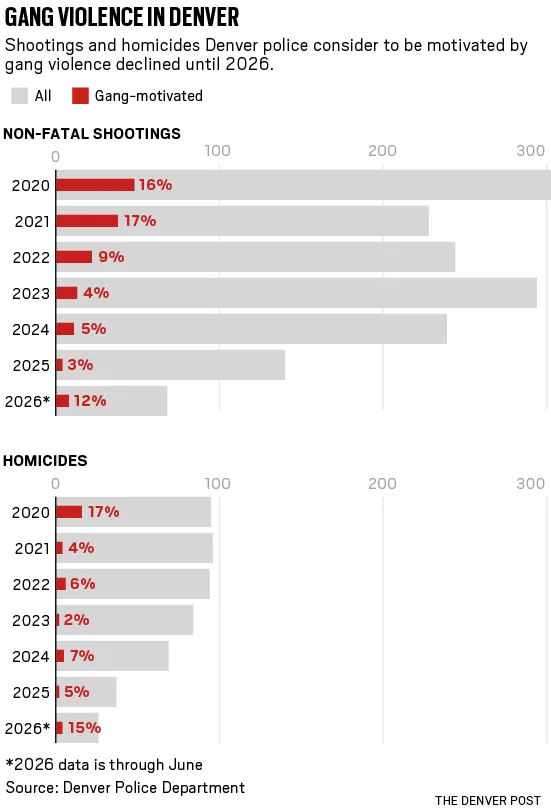
That year, the city saw 74 homicides with 36 teenage victims. In 2025, the city saw just 37 homicides, the third-lowest count on record since 1990 and the continuation of a downward trend after killings peaked during the COVID-19 pandemic.
Shootings and homicides Denver police labeled as gang-motivated have also declined over the last several years, aside from an uptick in the first half of 2026, police records show. The city recorded 28 gang-motivated shootings and homicides in 2022, 15 in 2023, 16 in 2024 and six in 2025, according to the records. In the first half of 2026, the police labeled eight shootings as gang-motivated and tied four homicides to gangs, about 13% of all incidents.
For many, the appeal of gangs is the community they offer, particularly for children growing up without present fathers, said Jackson, the defendant with Urocca in the 2011 murder. His grandfather and father spent time in prison, he noted. He was in prison for his own kids’ childhoods.
“I believe that pain is even (worse) for little boys growing up in the hood in a constant state of survival,” he said. “Not having a father around to guide you is a big deal and is the biggest reason why kids join gangs. They want structure, role models, and someone with answers to the problems they are facing.”
He’s also seen, again and again, how prison shapes young men, how being incarcerated with addicts, gang members and conmen slowly and surely pulls young men deeper into that world.
“Every time (Urocca) went to prison, every time he got out he was a little bit different,” Jackson said. “The crowd he hung out with was a little rougher, small disagreements were more serious, and the pack mentality was real. I’ve had a lot of friends who went from dudes from the hood to full-grown gangbanger and drug addict after one or multiple stints in prison.”
The violence that comes with gang membership perpetuates a vicious cycle of retaliation, said Halim Ali, founder of From the Heart Foundation, an Aurora-based nonprofit aimed at helping young Black men address trauma. He’s been mentoring a 16-year-old boy whose best friend was killed while sitting next to him when he was 12. The teen then killed someone when he was 14, Ali said.
“He said, ‘It’s not that I want to be involved in this life. But I have no choice. They killed my best friend. I have to kill somebody that they loved,’” Ali said. “…When you see that at 12 years old, your dreams go out the door. You are not thinking about graduating, or working or raising — and this young man just had a baby. It’s a perpetual cycle.”
The rise of social media contributed to the emergence of what Denver police call “hybrid gangs,” groups of friends in their late teens to early 20s who were brought up in or heavily influenced by gang culture, Schepman said in a statement. The groups form like any other friend group, but often turn to violence.
“The dangers of these groups come when they try to gain recognition or show dominance over other groups, and when there is no structure or influence that typically exists in traditional gangs to limit their actions,” he said. “They will commit crimes, sometimes violent, for the excitement or for status.”
Disrespectful or threatening messages on social media are often part of that attempt to show dominance, police said, and can quickly escalate to violence.
As Swazer was growing up, Tychinea told him again and again to avoid gangs, that that path led only to death or jail — and Swazer listened. He now coaches youth football players to try to pay forward the mentorship he received as a kid, to steer boys away from the streets, including some of Urocca’s sons.
“These kids are falling into this pipeline of destruction,” he said.
He finds that his influence is limited by what parents allow — whether single mothers trust him to mold their kids, whether adults get them to practice on time, whether they encourage or discourage gang life.
“It comes down to the way that people are raising you and what they’re allowing in your free time, with the way that they’re allowing you to mold and grow up,” he said. “That’s what makes the difference in humans.”
Parents can be a child’s biggest adversary, Ali said. Earlier this year, he walked into a 16-year-old girl’s birthday party to find the girl in a red wig and everyone wearing black and red, colors associated with the Bloods. Her mother had ties to that gang, he said.
“Her mother had the cake designer design a red rag on the birthday cake,” he said. “I left there like, ‘This little mama doesn’t stand a chance.’ Because it’s top-down. This is coming and being influenced by mom. So, whether you’re saying it or not, it’s what you’re projecting and exuding.”
Johntae fathered two boys before he went to prison. Now, he spends most of his time behind bars thinking, keeping his mind busy so he doesn’t go crazy in his cell. He thinks about everything: about how his mom told him to stay home the night he killed, about the people he thought were his friends and the choices he made. About breaking the cycle with his own young sons, who are now being raised without him.
“My kids can’t do the things I did,” he said. “What I did, it wasn’t cool, fun, exceptional nor funny. Where my dad messed up was he didn’t teach some of us that. So when I get home, I’ll make sure to teach my boys that. Because this lifestyle ain’t nothing fun or sweet, and if I don’t break it, it’s just gonna keep going over and over.”
IV. ‘My son is sitting in an urn’
Ja’Loynie “Taz” Cosey was taking a shower during a basketball team trip when someone in the group’s cabin started playing one of his favorite songs, “Great Gatsby” by Rod Wave.
The boy burst out of the bathroom, wrapped in a towel.
“He just opened the door singing it at the top of his lungs like he was the only person in the damn house,” said his coach, Julian Rose, founder of the Gold Boys Foundation, a youth basketball nonprofit. “He demanded everyone’s attention and we started singing the song with him. That’s just who Taz was. He wasn’t afraid to be himself, he wasn’t afraid to speak his mind and he always stood up for other people.”
Ja’Loynie, 13, was killed in September 2025, shot to death in a parking lot outside a house party on North Syracuse Street in Denver. Police arrested a 14-year-old son of Urocca Guyton in the death. The Post is not naming the boy since he is charged as a juvenile and has not been convicted.
Ja’Loynie was not involved in gangs, Associate Deputy District Attorney Makayla Samour said during a March court hearing. She described the teenager as a “completely innocent child,” who was gunned down while running away. The 14-year-old boy, she said, sprinted after Ja’Loynie and shot multiple times. The 14-year-old was out on bond on two serious cases — including an aggravated robbery charge — and committed the killing within a year of those arrests, she said.
Prosecutors in September agreed with defense attorneys that the boy, who is now 15, was incompetent to proceed — that is, he is too mentally ill or developmentally disabled to understand and participate in the court process. The murder prosecution has been put on hold until Urocca’s son can be restored to competency, a long-fraught process that can stretch for years. He was awaiting competency restoration on the first two cases when he was charged with killing Ja’Loynie, Juvenile Court Judge Lisa Gomez noted during the March hearing.
During those hearings in March and September, authorities discussed possible placements for the teen to live while his cases are pending — Urocca’s mother offered her home, but was not approved for the placement. Ja’Loynie’s father, who declined to speak with The Post for this story, repeatedly objected to the 15-year-old’s possible release.
“Here we go again,” Johnathan Cosey said in September. “My son is sitting in a urn. Where is his justice? You are talking about letting this boy out? My son ain’t getting out of no urn.”
Gomez twice found that the boy would stay in custody. He is attending school and responding to medications, officials said in court.
“I’ve been trying to do better,” the 15-year-old told the judge in March, reading from a letter he wrote. “I have my ups and downs… when I do get out, I am going to try to do the best for my family and me, and get a job.”
Many people had high hopes for the 15-year-old before the September 2025 killing. The boy was a talented football player, a leader among his peers, guarded until you earned his trust, said Allen Webb, a grandson of former Denver mayor Wellington Webb. He coached the boy’s football team when Urocca’s son was 10 and 11.
Allen Webb didn’t know the boy had been charged with murder, and he cried when he heard the news from a Post reporter.
“I’m surprised — I am, in a way,” he said, after taking a moment to compose himself. “But I’m not.”
He always worried about the boy.
“I used to tell my wife that there were a few kids on the team that if we don’t pour into them and show them love, the world is going to chew them up and spit them out,” he said.
The 15-year-old boy’s mother, Candice Martin, was in and out of jail as he was growing up, court records show. When he was almost a year old, Martin was charged with prostitution and attempted pimping after she arranged for herself and a 16-year-old girl to have sex with an undercover Denver police officer, court records show.
She faced drug charges a year later when police found suspected crack cocaine and a scale in her home; court records note that two children in the home were placed with social services.
In 2018, Martin was charged in a fight with a neighbor. That was the year Urocca died, when their son was 7.
When the boy was 8, he climbed into his mother’s silver Honda Accord outside their Westminster apartment and drove it out of a parking lot and into the street, crashing into a parked car on the way. The boy pulled a U-turn and returned home, running back into his apartment, afraid he was in trouble, according to a police report.
When police officers arrived, Martin appeared drunk and said she’d been drinking vodka all day, according to an affidavit. She was cited for misdemeanor child abuse and violating the terms of her probation, which required sobriety.
Then, not long after Urocca’s son turned 10, his 18-year-old brother was shot to death in Aurora on March 3, 2021. The police investigation revealed that his brother, Brian Harris, teamed up with a 23-year-old man to target a man Harris believed had threatened him with a gun a few days earlier.
Harris and the second man drove to an apartment complex on East Harvard Avenue and spotted their target, Ramon Grant, sleeping in a parked Jeep Cherokee, according to an affidavit. They made a plan to ambush Grant, beat him up and steal the man’s gun. Harris was armed with a Taser, according to a police affidavit.
But Grant fought back when they moved in, kicking and pushing the two men away as they tried to pull him from the Jeep Cherokee. Grant fired a shot, and Harris took off running. Grant then got out and fired several more shots as Harris fled. The teenager died from two wounds to his torso, including a shot to his back, according to the affidavit.
Grant, now 32, was charged with second-degree murder; he later pleaded guilty to manslaughter, was sentenced to eight years in prison, and has since been released on parole, court records show.
Outside a Denver courtroom in September, Candice Martin said her younger son was a good kid, responsible and resilient.
How did he end up charged with murder?
She pointed to her shirt, emblazoned with a photo of Harris. His brother died, she said. His father died.
Martin’s mother drank herself to death when Martin was 16, she said. Martin found her father dead in her apartment when she was 28. Martin’s half-brother, Antonio Davalos, was slain when he was just 11 years old, strangled to death in 2000. The boy’s frozen body was stuffed into a duffle bag and tossed in a trash bin in a case that set the wider Arapahoe County community on edge.
“What some people go through, we have went through 10 times over that,” Martin said. “But my boys are strong and they are very respectful. This situation… it’s breaking me.”
Martin faithfully attended her son’s football games and practices, Webb said, and if she couldn’t be there, she made arrangements for others to be. When the boy was 13, she spent a month in jail in Florida after she was arrested at the Tampa airport on an outstanding warrant for failing to comply with probation conditions in the 2018 Colorado fight case.
“I would do anything for my boys,” she said. “If they on the mountain, I’m going to that mountain. If they on the moon, I’m there.”
A couple of years back, during a long drive home from a team trip to Arizona, Webb asked Martin’s son about the killings of his dad and brother.
“His headspace was more or less, ‘Unfortunately, things happen and I do my best. I just want to make my mama proud and my brother who passed,’” Webb said.
In his anti-violence work, Ali focuses not just on the youth, but also on their parents, he said.
“Unfortunately for the mothers and the fathers, they’ve never received a certain level of support for their trauma. They’re still living out their own trauma while attempting to get their children help — but they’re not,” Ali said. “And that’s why we began a multi-generational approach… If that’s not the case, then what ends up happening is the youth are going right back to a toxic environment — a lot of times, the environment that caused the original trauma in the first place.”
Ali was raised in one of Colorado’s most notorious Blood families, the Fishers, he said. He changed his name in his early 20s, after going to jail and touching his daughter’s hand through glass.
“I didn’t want my children to be born under that banner, under the spirit of what was happening,” he said. “…I’m not going to hand down to my family what was handed down to me. This is where it stops. The rage, the anger, the criminal behavior, it dies with me. But that’s a hard decision to make when your whole social construct is built around family and holidays, because it’s not always bad. I mean, the joy you find being with family on holidays, the games you play, the times you share laughing — it’s like, I’m gonna give all that up? No, I can’t give that up. It doesn’t matter how toxic the toxicity is, this is still my family.”
But change is possible, said Lawrence Goshon, a violence prevention specialist at Denver Youth Program. His firstborn son got “gang member dad,” he said.
“He got all the teachings of, ‘This is how you be tough, this is how you are not a punk,’” he said. “These are the things you need to have to not be picked on and bullied. Because I was picked on and bullied when I was young… I brought all my trauma with me, like, ‘I don’t want you to be bullied.’ So in my mind I was teaching him how not to be bullied. I didn’t teach him all the right skills. I may have taught him how to defend himself. But there’s other parts of that — emotional intelligence, discernment, all of those type of things. All I did was teach him how to defend himself and probably how to be more angry.”
His oldest son is now serving time for a violent crime in the Colorado Division of Youth Services, he said. But he was a different kind of father to his younger son, Goshon said, as he himself learned to regulate his emotions and approach conflict in a healthy way.
“He’s a completely different kid,” Goshon said of his younger son.
He noted that cycles of generational violence happen in all sorts of communities, across races. Youth who witness domestic violence are at higher risk to become perpetrators later in life. Boys who are sexually abused are more likely to go on to abuse others as adults.
Still, he hesitates to blame parenting and environment alone. He didn’t grow up with gangs. As a young teenager, Goshon was drawn to gangs because all the girls at school dated Crips and he wanted a girl too, he said.
“Everybody wanted to be cool,” he said. “Everybody wanted to be accepted, which was where I was at. I don’t think it’s always about fathers and sons. I think it’s about acceptance, and what that looks like in your community.”
V: ‘Love wasn’t my issue’
Johntae Guyton got a neck tattoo as soon as he entered prison: a dollar sign with a crosshairs, a reminder of why he will spend much of his adult life behind bars.
“It was just money,” he said. “I wanted more and more money.”
He does not blame his parents for his choices. His mother and stepfather always tried to steer him straight, he said.
“I didn’t have to struggle because my parents, I struggled because of my hard head and dumb choices of thinking I knew everything when it came to getting money in any and every way possible,” he said in an email from the Colorado State Penitentiary in Cañon City. “Then when I was wrong, I didn’t know how to accept that and just be better next time instead of doing everything my way, the wrong way, even when I knew it was wrong.”
Denver police arrested Johntae three times when he was 14 — for trespassing, weapons and theft. Each time, prosecutors didn’t file charges in Denver Juvenile Court and the cases were closed and expunged. Johntae carried a gun, he said, for his own safety.
“Imagine someone who hates you — and probably will always hate you — has a gun and you don’t,” he said. “You’re with your family, then they see you. You think he’s going to talk to you about how much he hates you? This generation (of) people don’t know how to fight and take a loss. If I didn’t have a gun the day I did, I would be dead right now.”
He was shot in the thigh at 17, Johntae said. He was arrested that same year, in February 2022, for car theft. That Denver juvenile case was dismissed through a plea agreement.
Two months later, Johntae was charged in Denver with possessing a handgun and a large-capacity magazine. He pleaded guilty, and in July 2022 a judge granted him a diversion — meaning the case would be dismissed if he met court conditions and didn’t get into more trouble for a year.
Five days later, he killed a man in Lakewood.
The killing happened just after midnight on July 31, 2022. Johntae, then 17, joined up with Keandre Mims, then 28, and a teenager near the intersection of West Colfax Avenue and Sheridan Boulevard. At about 12:12 a.m., the trio approached a bus stop on West Colfax — at least two of the group with guns drawn — and attempted to rob the people at the stop. Surveillance video shows one man drop a backpack and retreat over a low wall. The trio chase him at gunpoint until he falls to the ground, then appear to go through his pockets.
The trio retreated to a gas station, where they are seen on video talking to a man in a stolen Subaru. The man in the Subaru and the trio then go to a car wash a couple of doors down at 1431 Sheridan Blvd., where Ramon Castro Contreras sat inside his vehicle, parked in one of the car wash’s bays.
The man in the Subaru pulled up behind Castro Contreras, blocking the rear exit. Then Johntae, Mims and the second teen rushed Castro Contreras’ driver’s side door. Mims lunged for the door handle and slammed what appeared to be a gun into the car. Castro Contreras took off. Mims and Johntae both opened fire, according to a police report. A bullet struck Castro Contreras in the heart. He died in his car, which came to rest about 300 feet away.
Johntae, Mims and the teenager collected shell casings from the ground before they ran. Hours later, Johntae took a photo of himself at Mims’ home, pointing a gun at the camera with the words “Bye Hoe” written across the image.
Then, investigators believe, Johntae went on to commit two more robberies in just over 24 hours. At about 6:30 p.m. on July 31, 2022, four suspects attacked men in Montbello, pistol-whipping one victim as they stole the group’s cellphones. At 2 a.m. on Aug. 1, investigators believe he robbed a Taco Bell in Thornton with at least two others, pointing guns at workers and taking cash.
“You know how it is when you are with your homies, it’s not like, ‘Bro, I’m leaving,’” Johntae said.
A few hours later, at about 9:40 a.m., Denver police arrested Johntae in a stolen car in the 1300 block of East 31st Avenue. He backed up to try to flee and crashed into another parked car before they put him in handcuffs.
“I messed up thinking I knew everything about getting money and life, even though my mom and my stepdad told me the right way to go about life and jobs,” he said. “I still continued to do things the way I thought would be more effective, even though I knew the risk could be high — but I didn’t care it being this high at that age.”
Mims, the man in the stolen Subaru and the second teenager were each charged with murder. Mims was sentenced to 96 years in prison; the driver of the stolen Subaru was sentenced to 40 years in prison. The outcome for the second teenager was not clear because Colorado law keeps juvenile criminal records secret.
Johntae pleaded guilty to second-degree murder in a deal that ensured he’d receive a sentence of between 36 and 46 years in prison. At his 2024 sentencing, Castro Contreras’ sister, Blanca Castro, remembered her youngest brother as caring and protective, always willing to travel to see his family. She objected to the plea agreement and declined to speak with The Post for this story, not wanting to give more attention to her brother’s murderer.
“As you can see in the video, he didn’t act like a beginner,” she said during the sentencing. “They planned very well what they were going to do. He knew that he — he was carrying a gun, he was going to either let him go or fire his gun. Unfortunately, he killed my brother, but it could have been anyone, any of the people that they were robbing that night.”
Prosecutors asked for the maximum possible sentence of 46 years.
“The defendant was heavily entrenched in gang activity from a young age,” said Kayla Wildeman. “…He had no intent of stopping or removing himself. It was because of the fact that he committed this heinous crime that he was stopped.”
Johntae apologized to Castro Contreras’ family and said he hoped to repair the damage he had done. Before the killing, Johntae had been living with Urocca’s mother and had been doing well, attending therapy and even school. But he returned to his mother’s custody that summer when his grandmother left for a trip, and his mother was focused on raising his younger siblings, Johntae’s attorney, Holly Gummerson, said in court.
“It’s not like I’m like this because of my family or my mother, because my mother really loves me, and I know she does. And I love her too. Love wasn’t my issue,” Johntae said during the hearing, then mentioned his father’s slaying when he was 13. “A young child doesn’t understand when you see someone leave and not come back. …I was angry with the whole world, basically.”
Jefferson County District Judge Jason Carrithers found that Johntae had “an obsession with guns,” and said the teenager received multiple chances to turn his life around, noting the numerous juvenile cases that were dismissed, dropped and deferred.
The judge imposed the maximum 46-year sentence. Johntae will be eligible for parole in 2056, when he is 51.
“It is true that this was senseless. It is true that this is a tragedy,” Carrithers said. “And I do recognize the — this isn’t an impact on just the Contreras family. I recognize the impact on Mr. Guyton and his family as well, and a very sad cycle that exists in our community for families that are involved in gangs or abuse, neglect, or poverty or whatever it may be, and how difficult that cycle can be to break.
“Here, unfortunately, I hope I’m wrong,” he added, “but we have the setup for yet another cycle, with a young father going to prison with two young children at home who are either going to glorify everything you have done or run away from it. And we’ll see if that cycle finally gets broken.”
Read more 2 Pueblo officers injured hit by ‘friendly fire’ in shooting that left Pueblo man dead
Sign up to get crime news sent straight to your inbox each day.
Read more International recruiting still key across CU Buffs athletics despite changing times