







In an increasingly commercialized youth sports landscape, Thomas Trotman is good with going into the red.
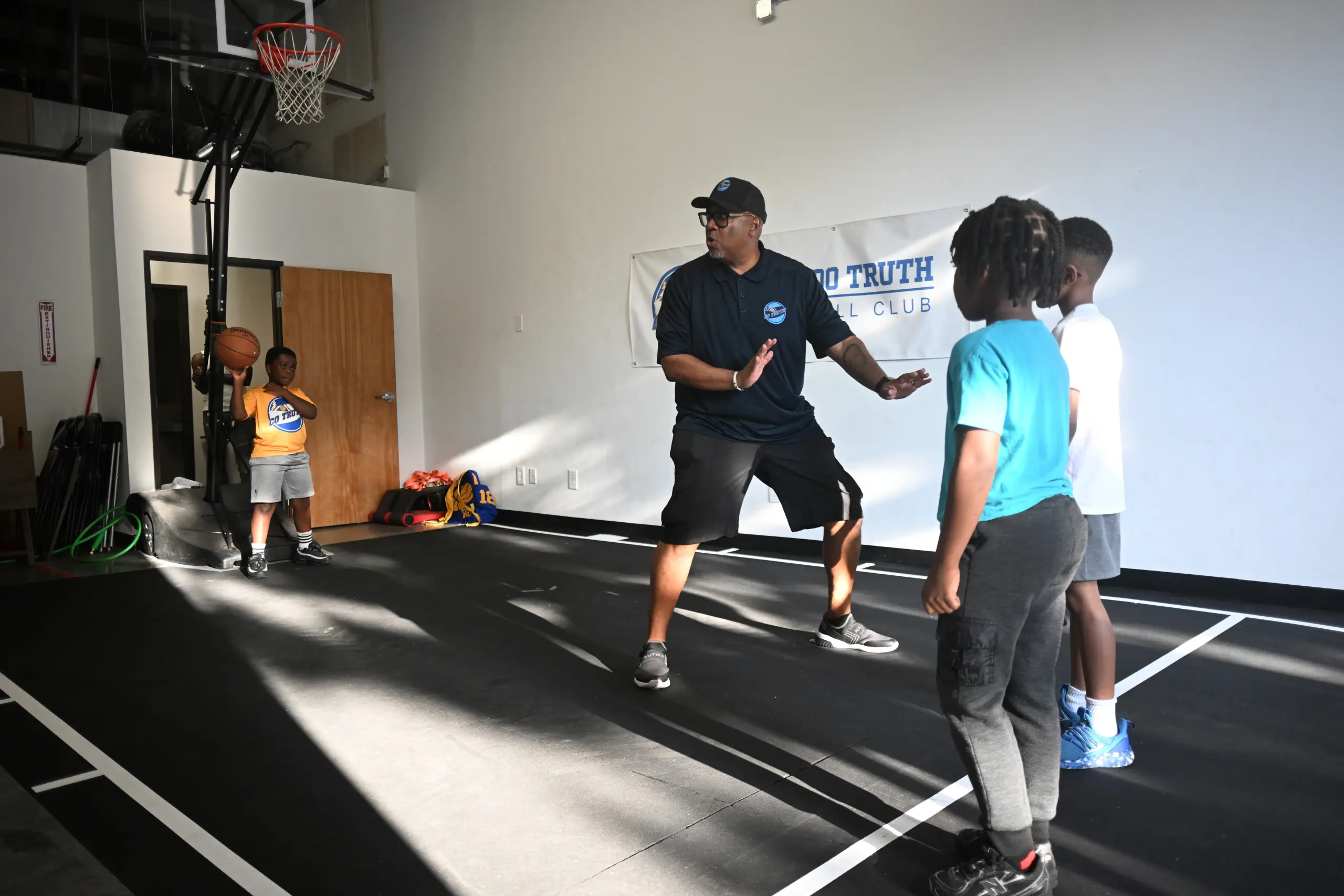
Travel youth sports have created an economic gulf between families who can afford to pay thousands of dollars per activity annually, and those who cannot. Trotman witnesses firsthand the divides that exist as a director for a local basketball club, Colorado Truth, and is OK with losing money to support the players he calls “rec center superstars.”
“For me, it’s all about that kid who never got on the (elite travel) circuit, that kid that never got to go to a travel tournament — that kid who can play, but his family doesn’t have the money,” Trotman said.
“So the entire summer he’s been at the rec center and his game’s getting better. He’ll get to play for his high school team in the winter, but guess what? That kid didn’t play spring or summer ball at all, because of how expensive club basketball has become. How sad is that?”
According to a 2024 cost-of-sports study , 75% of parents whose kids have played sports say they have “strongly considered pulling their children out of sports.” Of those respondents, 21% cited the unsustainable cost of participation, and 18% of parents with kids who were new to sports said they went into debt to pay for their kids to participate. And 56% of all parents surveyed said they were worried about not being able to pay for sports the next year.
As youth sports have evolved into a $40 billion-plus annual industry, some fear that across all sports, the “rec center superstars” who come from lower-income families or rural communities are going to get permanently left behind.
Added to this is the fact that in many sports, including boys/girls basketball and baseball, Division I recruits sometimes get “scholarships” to play for free — even if those players’ families can afford to play — because clubs see their presence on rosters and their college commitments as a marketing opportunity.
“In Colorado specifically, we are actually seeing an increase in youth sports participation, but we are mostly seeing that increase amongst white males,” explained Caleb Coats, the project director for Project Play Colorado. “And so we still have substantial opportunity gaps in subsets of the youth population.
“You have entire pockets, even in populations that theoretically have access, that don’t have access because they just aren’t in the right zip code. We are seeing a disparity because there’s kids that don’t have the resources, which in Colorado tend to be the kids of color and marginalized communities. They aren’t playing at the same rates because you still have a financial barrier that has not been addressed.”
In Colorado youth basketball, Trotman says the state’s club scene has two distinct factions. One is grassroots organizations, which are fine with breaking even financially. But he also asserts that “we have some very greedy dudes” running club programs, ones who are “paying their mortgage from this, because there’s no way you’re charging families $5,000 for a summer set.”
That disparity is why Trotman insists on not emulating the club model that he sees consistently employed in Denver’s affluent suburbs, where he says certain clubs seize economic opportunity with as many teams as they can fill and “you better believe they’re eating it up. They’ll name all their different teams at each age group with as many colors as they can think of. And if their A team is doing well, they don’t care how the turquoise team is doing.”
Trotman says he goes into his own pocket to fund his club, including paying for gym fees and team insurance. He also created a gym in the warehouse of his construction equipment business, buying a container to store equipment that is usually kept there so the space could be converted into a half-court basketball court with a single hoop. And he’s also paid for scholarships to fund travel and uniforms for players in need.
“If God could pull out a ledger right now, of how much I put in out of my pocket versus how much I’ve taken from parents, my wife would kill me,” Trotman said with a laugh. “And now I’m pulling all my equipment out of my own damn shop, and I’m opening up my little small gym for the community for the entire summer.
“My wife wanted to kick my (butt) once again, because now I have to pay for this container. But it’s because I’m in this truly for the passion and development. I wouldn’t do this any other way. I’m losing money and I don’t care — and there’s a bunch of (club directors) who would laugh at me for saying this — but I’m doing it because people did it for me when I was growing up right here in these same neighborhoods.”
Death of the neighborhood team
Gary Thrapp, a youth sports expert and author who runs a nonprofit sports facility in Iowa, says communities need more stakeholders like Trotman who do not view youth sports as a commercial venture. An increase in that approach is the only hope to close the economic opportunity gap, which is widening by the year.
“Just about every community (in every American city of decent size) has elite clubs going on now,” Thrapp observed. “But what is that community doing for the kids who don’t have a lot of money? We desperately need people in our communities to focus on that.”
While that gap doesn’t appear to have any solution anytime soon, with it comes a structural change to how youth sports operate.
Twenty years ago, it was more common for kids to grow up playing a specific sport with the kids in their neighborhood and/or school attendance area. Those teams often stayed together from elementary through middle school, and that chemistry would carry over to their high school team.
But while clubs have embraced a for-profit approach over the last couple of decades, athletes and their families are, in turn, taking an individualized mindset to travel sports. Long-term loyalty to a specific coach or team is hard to come by. Roster turnover is high, especially for costly teams that carry expectations of winning.
Mike Vavra, a softball parent and baseball coach who is plugged into local club sports through running Locker Room Sports in Parker, says the roster turnover he sees in travel baseball is “the highest it’s ever been.”
In late June each year — when club tryouts for the next spring take place, complete with contracts offered to families and deadlines as short as 24 hours attached to sign those contracts with a deposit — club baseball free agency reaches its zenith.
“The better the team, the more turnover usually,” Vavra said. “With those top teams, one loss can be a big deal. Or if you go out of state and you don’t meet the expectations by winning, you blow up. It’s like those teams are the Yankees — if you don’t win the World Series, revamp the whole team.
“Also, with those teams, there’s the playing-time issue. Everyone’s parents think they should be the pitcher or the leadoff hitter or whatever. You promise everyone the world to get them on the team, because you got this all-star team. But then it comes down to who earns it, and the parents often don’t like that. Then you’ve got the daddy-ball issue.”
Vavra says the .500 teams are generally the safest, but that doesn’t mean they can’t implode, too. The losing teams, Vavra says, are at risk of having their best players poached by better teams.
And parent-coach conflicts, as well as what some believe are unrealistic parent expectations, are also at the root of the roster turnover issue.
“Because parents are now spending thousands of dollars, they feel like they should have a say and they’re way too involved in the process,” said Scott Hormann, who runs the baseball club USA Prime Colorado and is also Lutheran High School’s head coach. “… I also think parents are looking for something that at 10, 11 and 12 years old shouldn’t be looked for. They care more about winning than development. They care more about status than they do what’s best for their kids.”
Effect on non-travel competitive leagues, rec
While the club scene across a range of sports lacks team continuity, it doesn’t lack numbers or an overall talent pool.
The latter is now the problem for recreational leagues — which have essentially become platforms for beginners — as well as for the competitive, non-travel entities in between, such as the Arapahoe Youth League.
The AYL is losing kids and entire teams earlier and earlier to travel. Kristy Thomas, who has been the administrator for the Parker Hawks (the largest club in the AYL) for 18 years, acknowledged it’s “the new reality we’re in right now (as the AYL).” Football, which has been largely insulated from the travel sports phenomenon, remains the AYL’s stronghold. But many other AYL sports are feeling the repercussions.
“Other clubs’ numbers keep dropping — every year the Warriors have less teams, the Raptors have less teams, Cherry Creek has less teams,” Thomas said. “And some of those clubs don’t even offer, say, girls’ softball anymore, or they’re not even trying to offer volleyball anymore. Most of them are still doing basketball, baseball, and football. But some of them aren’t even offering the other sports, and that’s because of (travel sports).”
Meanwhile, recreational leagues — often run by the local city — have seen their talent level drop significantly. Entities like the AYL are the new baseline for competitive play.
Matt Baumgartner, a youth sports dad in Denver, largely kept his sons out of travel sports. Last year, his eighth-grader traveled out of Colorado with his football team at a cost of about $4,000 because the team was dominating everyone in the state. Baumgartner believes that “travel clubs are ruining kids’ sports,” but also saw a catch-22 scenario with his oldest son when he played rec baseball in middle school because Baumgartner didn’t want to shell out thousands of dollars for travel ball.
“He had a horrible experience because some of the kids couldn’t even catch the ball by the time he was in seventh grade, because I wouldn’t put him on a travel team,” Baumgartner said. “So we just got frustrated with the talent level. The issue is, all the club teams (siphon) all the talent away from it. I never put my kids in any competitive league where I saw where it was money ball. I was never going to do that.
“I was like, ‘Well, if they’re the best person in the league and they’re dominating it, we’ll figure it out at that point.’ Until then, I’m not going to push my kid in that direction. But then again, I kind of feel bad I didn’t do that for baseball for my oldest. Because really, it pushed him the other direction. He was like, ‘The kids suck, I hate this, I’m bored, and I don’t want to be here anymore.’”
Graham Baughn, the head baseball coach at Thomas Jefferson and a mental performance coach with the club Rogue, believes there’s no going back from that trend across all sports.
“For an outlet for even mediocre players, rec ball leagues are going to continue to die off as an option,” Baughn said. “It’s going to be kids that are not very good, and they do it as almost a babysitting thing where it’s something for them to do, but it’s not serious and you’re not seeing kids develop at that level at all because there’s nobody (of high-caliber coaching) left there to teach them.”
Burnout, too many games, parent pressure
While elite clubs can offer the most qualified coaches and premier facilities, that also brings a level of pressure and commitment that can sometimes be overwhelming.
Cade Austin experienced that firsthand after growing up playing in the Colorado Rapids Academy, the highest level of local club soccer. The emphasis of that development academy is not simply a college scholarship; as the club’s tie-in with the Rapids indicates, its focus is also on molding future professional players.
But by the time Austin got to high school, approaching the sport through a pro lens throughout his adolescent years started to wear on him.
“It’s really easy to fall out of love with the game when you start adding all these external pressures to yourself when you’re young,” said Austin, now 25. “I ended up coming to a crossroads where I didn’t feel like I was loving the game.”
Austin says the individualized culture of the club – “it was all these kids trying to go pro rather than players who were really a part of a team and trying to win something” – as well as training five days a week led to burnout.
“I started feeling anxious when I’d go to training,” Austin said. “I was driving from Broomfield to Commerce City every day to get to the Rapids’ facility. Then every day you have to show up and give your best effort. And I just wasn’t feeling love for doing that.
“I wanted to feel more a part of a team and not all of that individual pressure. It was my dream to try to be a pro soccer player and try to play in college. And when I started realizing that that didn’t seem like it was going to happen for me, I started getting burnt out.”
In Austin’s case, the large financial commitment that club sports requires wasn’t a factor, because playing for a Major League Soccer academy meant the Rapids paid for everything, including uniforms, tournaments and travel. And while he says that some of his former teammates did end up going pro, he also believes “a lot of people don’t understand how hard this pursuit (through top-level club sports) is.”
Read more Colorado man arrested in suspected vandalism ‘became unresponsive’ after police confrontation
“It is an insane commitment because every single day, every hour you’re making a choice to want to go and pursue this thing,” Austin said.
Austin is not alone in the sentiment that the love of sport often gets lost when playing the highest level of travel sports.
One of the key findings of Project Play’s 2025 youth athlete survey was that elite sports achievement is a secondary motivator for most players. Only 12% of the 3,827 kids who were surveyed nationwide said that “earning a college scholarship or roster spot” is one of their favorite things about playing.
“Having fun and playing with friends are by far the top reasons children and adolescents play sports — motivational factors that sit in contrast to the messages often sent by an increasingly commercialized youth sports system that prioritizes winning and the lure of college athletic scholarships,” Project Play research director Jon Solomon wrote in the study’s summary.
While Austin continued to play club soccer, he did so not at the academy level, and he says his love for the sport returned when he played for Broomfield High School. He eventually walked on at the University of Denver, a Division I program.
He was the only player on his DU team who didn’t play on a development academy team throughout high school, but his atypical route worked for him.
High school basketball player Reed McCubbin is hoping zigging while everyone else is zagging works for him, too.
The Arapahoe senior guard played club basketball for the Elevation Flyers from fourth through eighth grade, but quit club entering high school. McCubbin, who has some college interest but no offers yet, stopped playing travel basketball because he felt like it didn’t give him enough time to work on developing his size and his ability.
“The two main focuses for me the last few years are gaining strength and gaining skill, and it’s so hard if you’re playing as many games (as club teams do) to get all your weight training in, to get all your individual skill work in,” McCubbin said. “It’s super tough to balance it all.”
Because of that, McCubbin and his family decided to take the approximately $7,000 the family was spending on travel basketball each summer and reallocate some of that money to a strength trainer and a skills trainer. That now fills his schedule each week in addition to solo work.
He says that approach has helped him establish himself within Arapahoe’s program, where he made the varsity team as a junior.
“My ultimate goal is to play college basketball and at the end of the day, I think this gives me the best chance to be healthy, to gain weight, to increase my skills and do everything I can that matters at the college level,” McCubbin said.
McCubbin, who still plays tournaments at team camps for Arapahoe during the summer, says an overload of games takes its toll on his body and his mind. Usually, travel tournaments in many club sports require teams to play multiple games in a day, and teams can end up playing as many as seven to 10 games over a three-day weekend.
“When I’m playing my third game of the day, my knees hurt, and I’ve already taken two Ibuprofens,” McCubbin said. “I love basketball. But at some point you’re like, ‘This is not fun.’ At some point, you’re just playing games to play games.”
McCubbin also points out that the burnout from club sports that Austin describes has been a common thread among McCubbin’s basketball peers. The majority of the kids McCubbin played with as a freshman are no longer in the sport, and McCubbin attributes this partly to parental pressure.
That anecdotal evidence is supported by one of the key findings of the Project Play athlete survey, which found players who quit reported higher rates of “negative parental behavior” when they played. That includes being pressured to play when they didn’t want to (21% of former players said so) and being compared to other players (18% of former players).
“A main factor in burnout is definitely parent pressure,” McCubbin said. “… There’s so many kids I know whose parents just threw them on the AAU circuit, and the AAU circuit spit them out. They don’t really love basketball, but they played travel basketball because of the pressure from their parents.
“Ultimately, they get sick of that and quit because they want to do other things that they actually enjoy.”
Pursuit of the college scholarship
While the toll that travel sports take on the individual athlete can vary, a significant motivating factor for parents to continue funding their kids’ travel sports journey, despite potential physical and psychological drawbacks, is the pursuit of playing at the next level.
That is despite slim odds for athletes making it from high school to the NCAA.
Only about 8% of high school athletes go on to play in the NCAA, according to the 2024-25 data. In the most high-profile sports, 8.1% of high school football players will play in the NCAA, along with 3.6% of boys basketball players, 8.8% of baseball players, 4.7% of girls basketball players and 7.9% of girls soccer players. But those statistics are even lower when it comes to making it to Division I, where there is the most scholarship money and best chance of Name, Image and Likeness money to be made: under 3.5% in all those aforementioned sports.
“I ask parents this all the time: Are you willing to spend the equivalent of a college education to try to earn a free one for your kids?” Thrapp said.
Dr. Travis Dorsch says the pursuit of playing in college “comes down to parents’ pride, too.”
“I think parents get so wrapped up in the destination that they kind of forget about the journey,” said Dorsch, a Utah State professor and expert on youth sports. “And now there’s so much more chum in the water in terms of NIL opportunity.”
Recruiting camps have become part of the youth sports ecosystem, as have tournaments where parents believe their athlete could get exposed to college coaches. For elite athletes, there are certainly success stories of players being scouted via both venues.
But for many of those camps and tournaments, the college coaches’ eyeballs and attention that parents are promised when signing up don’t necessarily come to fruition.
“A lot of (those camps) are just come out, throw your bullpen, take batting practice, get your metrics — here’s your data, thanks for your money, see you later,” Baughn said. “It’s always my recommendation to do homework and understand why you’re paying (several hundred dollars) for your kid to participate in this camp. If there’s no coaches there and you’re doing it for recruiting, you just wasted a bunch of money.”
Dustin Baldwin, a baseball parent whose high school son is committed to the University of Washington, says there are similar issues with tournaments that tout college exposure.
“Name the elite tournament that you go to, and they say things like, ‘We’re going to have 150 college coaches there,’” Baldwin said. “Well, they’re not there on Day 1. They’re there on the last day, championship day, and they’re watching the best teams and talent. There’s times where (my son’s team) wouldn’t even make it to championship day. So it’s like you go to these things that are advertised to be big recruiting events, and then you’re not even playing on the big recruiting day.”
Christian Lavers, the president of the youth soccer circuit Elite Clubs National League, explains that all the aforementioned factors are why parents should not include the possibility of a college scholarship as part of the economic calculus for their investment in a specific sport.
“If anybody is doing any of this because they think there’s an economic return down the road, whether that is a college scholarship or NIL, that is the wrong reason to do any of this,” Lavers said. “You invest in sports because it’s good for the kids to be active. It’s good for the kids to be healthy. It’s good for the kids to compete. It’s good for the kids to learn all the lessons that can be associated with sports when it’s done well.”
Two longtime Colorado high school coaches echo Lavers, noting that the state doesn’t have enough Division I athletes to justify the widespread return on investment that club teams often promote.
Regis Jesuit baseball coach Matt Darr notes that most of the state’s college commits go on to play Division II or lower, where athletic scholarship money is much sparser and NIL is nearly nonexistent.
“The club model’s pushing for a Division I scholarship, but that’s pretty tough in baseball and parents are not going to get a great return on their investment for that,” Darr said. “DII and DIII are the sort of schools that 90% of Colorado players need to look at, where they can get academic money but they’re not going to get baseball money. So the club model is designed for only a few kids that fit that ability athletically.”
Arapahoe basketball coach Kevin Boley, who has experience in the club realm as a coach and a parent, notes that playing club helps players improve for their high school team. But he points to how recruiting has changed, and agrees with Darr that the talent level in Colorado boys basketball largely doesn’t justify pursuing a Division I college scholarship in the sport.
“Predominantly, Colorado boys basketball players are going to be DII, DIII, NAIA type kids,” Boley said. “But college coaches now, first they recruit their own kids (to return). Then they go to the transfer portal. Then they go to the JuCo level. Then they go to prep schools. Then, lastly, they look at high school kids.
“… If you are a legit college-bound basketball player, so you’ve got the size and you’ve got the skills, there’s great value in playing club basketball if it’s with the right club in the right situation. But if you’re a parent and you think that if I put my kid in a club organization and the payout for this is going to be a Division I college scholarship, you’re probably missing the boat. All the money you’d spend on club and travel, you could probably (help) pay for your kid’s college with that.”
Amid that pursuit of the next level — and the positives of commercializing youth sports — Thrapp says social media is the conduit fueling the industry’s emotional flame.
“We’re just looking for a highlight and lowlight film,” Thrapp said. “And the players, even if they’re not getting recruited, everything’s recorded, so they can cut up their highlights and post them. Alongside that, we see the coach getting kicked out, the horrible parent captured on camera, the coach fighting the umpire.
“We also see the best dang play of the season. We see the huge spike (in volleyball) and the big dunk (in basketball). All of this separates us from the everyday reality of what it truly takes to be good.”
READ PART III NEXT: Youth sports costs are skyrocketing. Some Colorado parents and kids say ‘it’s worth every dime.’
Want more sports news? Sign up for the Sports Omelette to get all our analysis on Denver’s teams.
Read more PHOTOS: 9th annual Swim Across America – Denver
Read more Pay to Play