




There will soon be a little less of Centennial to love — 18.03 acres less, to be exact.
Read more In Broomfield, man dead after a shooting at police scene, department says
Next month, the city will bid goodbye to a parcel at the northwest corner of East Arapahoe Road and South Olathe Street that’s owned by Regis Jesuit High School. It will revert to Arapahoe County’s oversight in a rarely used legal process in Colorado known as municipal disconnection.
Before year’s end, the largely vacant property is expected to be absorbed into Aurora through an annexation request from the high school, boosting the size of Colorado’s third-largest city by the same 18 acres and change.
It’s unusual for a city in Denver’s expanding suburbs to willingly give up territory, and the proposal initially landed with a thud for a Centennial city councilman who’d lose part of his district.
“I never expected to shrink my city,” Councilman Don Sheehan said. “My first reaction to the proposal included words not suitable for print.”
It’s an understandable reaction from an elected leader in one of Colorado’s newer municipalities. Centennial became a city on Feb. 7, 2001, and has been on a steady growth trajectory over the last quarter-century. The city, with a population of nearly 110,000, covers just over 30 square miles south of Aurora and east of Littleton.
When the details of the jurisdictional shift were sorted out, however, Sheehan’s concerns about becoming a diminished city were allayed.
“In the end, the positives outweigh the negatives for all concerned,” he said.
The Centennial City Council approved the disconnection on June 16. It goes into effect in mid-July.
For Regis Jesuit High School, which initiated the disconnection process two years ago, it came down to a desire to consolidate its campus on South Lewiston Way fully into Aurora, where it opened 36 years ago.
But the school’s history goes back much further. Founded by Italian Jesuits in 1877 in Las Vegas, New Mexico, the school soon made its way to northwest Denver, where it was located on the campus of Regis University. Both entities formally separated in 1979, and a decade later, the high school moved south to Aurora.
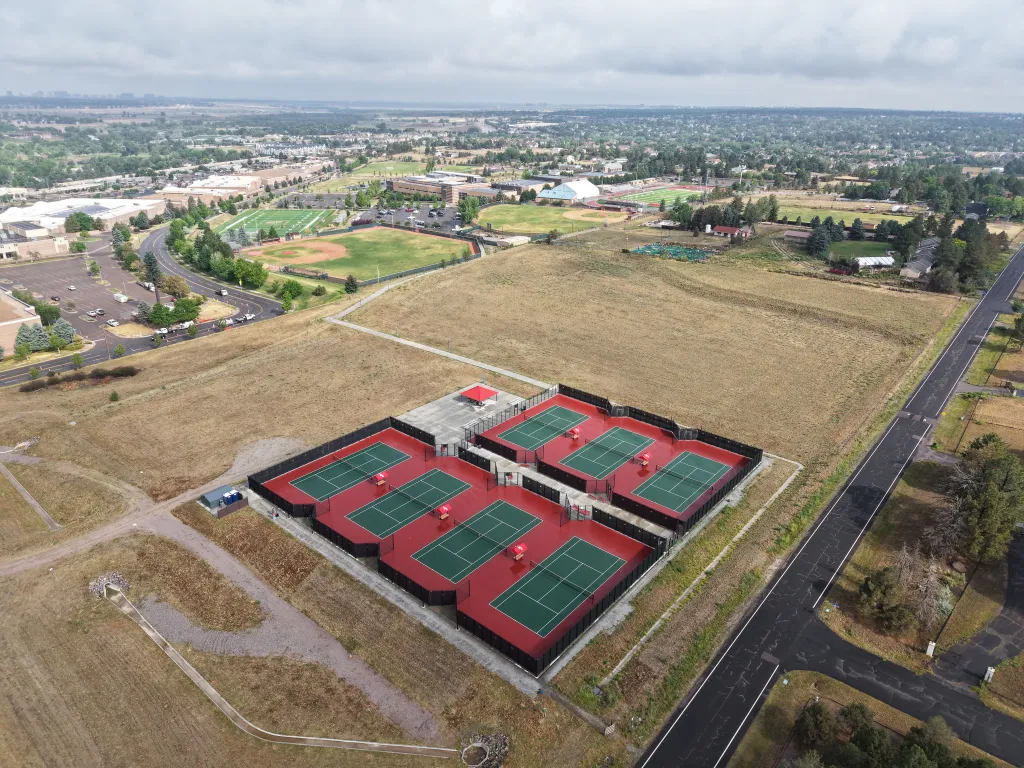
Regis Jesuit, which enrolls around 1,600 students, bought the 18-acre parcel in 2017 with plans for it to host multipurpose artificial turf fields, a fieldhouse, a retreat center and a 175-space parking lot. Regis Jesuit built seven tennis courts on the land three years ago.
Diana Rael, the vice chair of the private Catholic school’s board of trustees, said having the southern portion of the campus in a different city from the front office just a few hundred feet away is a recipe for confusion and aggravation.
From who provides water (Aurora Water charges a premium to provide water outside its service area) to which city’s land-use codes apply to who responds to 911 calls at the school, it all adds up to a bifurcated mess, Rael said.
“Being in two different cities for emergency services is very confusing,” she said. “Essentially, all of our utilities go through Aurora. It’s a melting pot of codes out there.”
Municipal disconnection is “extraordinarily rare” in Colorado, said Andy Peters, a land use attorney with Otten Johnson Robinson Neff and Ragonetti.
“The possibility of disconnection is typically used as leverage in a conversation about what a landowner could get from a city,” he said. “People rarely go through with it.”
Rare doesn’t mean never. Centennial itself has approved disconnections twice since the city’s inception — once in 2007 and once in 2013.
And two years ago, Greenwood Village disconnected a 5.78-acre parcel stranded from the rest of the city by Interstate 225, according to a story in BusinessDen. The land was transferred to the jurisdiction of Arapahoe County. At the heart of that move was the city’s stated inability to meet adequate emergency response times to the property, where a developer planned to build homes.
Read more Today in History: June 26, first Harry Potter novel published
Neil Marciniak, the economic development director for Centennial, said the city made sure to come away with an agreement with Regis Jesuit that looked out for its interests, too.
“We understand Regis’ desire to consolidate their campus in one jurisdiction,” he said. “And we fully expect Regis Jesuit to continue being a good neighbor to residents of our city.”
The disconnection agreement comes with a list of conditions designed to ensure that the property’s future absorption into Aurora doesn’t turn into a nightmare for residents of Centennial’s Cherry Creek East and Lazy Hills Ranchettes neighborhoods to the east.
“We wanted to make a crystal clear agreement about what land uses are allowed and what land uses are prohibited,” Marciniak said.
Regis Jesuit can’t build a stadium, a mortuary, a group homes or after-hours clubs on the 18 acres. It is also barred from placing a marijuana dispensary or a sexually oriented business on the property, the agreement states.
“That’s probably not something a private Catholic high school would be looking to do,” Rael said wryly.
There are more practical land use limits in the agreement. The height limit of any building would be 38 feet along the eastern edge of the parcel, with an exception for a 60-foot-tall fieldhouse on the west side.
“If there are buildings, they need to push them as far to the west of the property as possible,” Marciniak said.
Regis Jesuit’s facilities must screen its athletic operations from the nearby neighborhood with trees and landscaping. Access to the parcel will be restricted from Arapahoe and Olathe, forcing traffic to enter the school’s property from Lewiston Way in Aurora.
Those concessions helped sell the disconnection to Sheehan, the Centennial councilman. Because the high school is a nonprofit entity and isn’t taxed, it sends little revenue to the city. Yet Centennial has had to provide public safety services to the property, Sheehan said.
“From a fiscal standpoint, it’s a net positive to the city to not be serving this property any longer,” he said.
While losing 18 acres may look bad on paper for a city, Centennial has, on net, gained far more land than it has lost. In fact, the city was on a bit of an annexation tear a decade or so ago, inviting criticism from Arapahoe County residents that Centennial was engaged in a land grab.
Similar protests a decade and a half earlier were what led to Centennial’s incorporation in the first place. In the 1990s, residents in unincorporated Arapahoe County grew tired of Greenwood Village’s attempts to annex adjoining land to bolster that city’s tax base.
After a legal challenge that went all the way to the Colorado Supreme Court, voters living inside the proposed boundaries of Centennial approved the city’s formation in 2000.
Once the new disconnection from Centennial is complete, there are just a few details to work out, as Regis Jesuit prepares to file a formal annexation application with Aurora. It can’t come soon enough for the school.
“We’re ready to submit tomorrow,” Rael said.
Get more Colorado news by signing up for our daily Your Morning Dozen email newsletter.
Read more Today in History: June 27, first ATM unveiled near London