
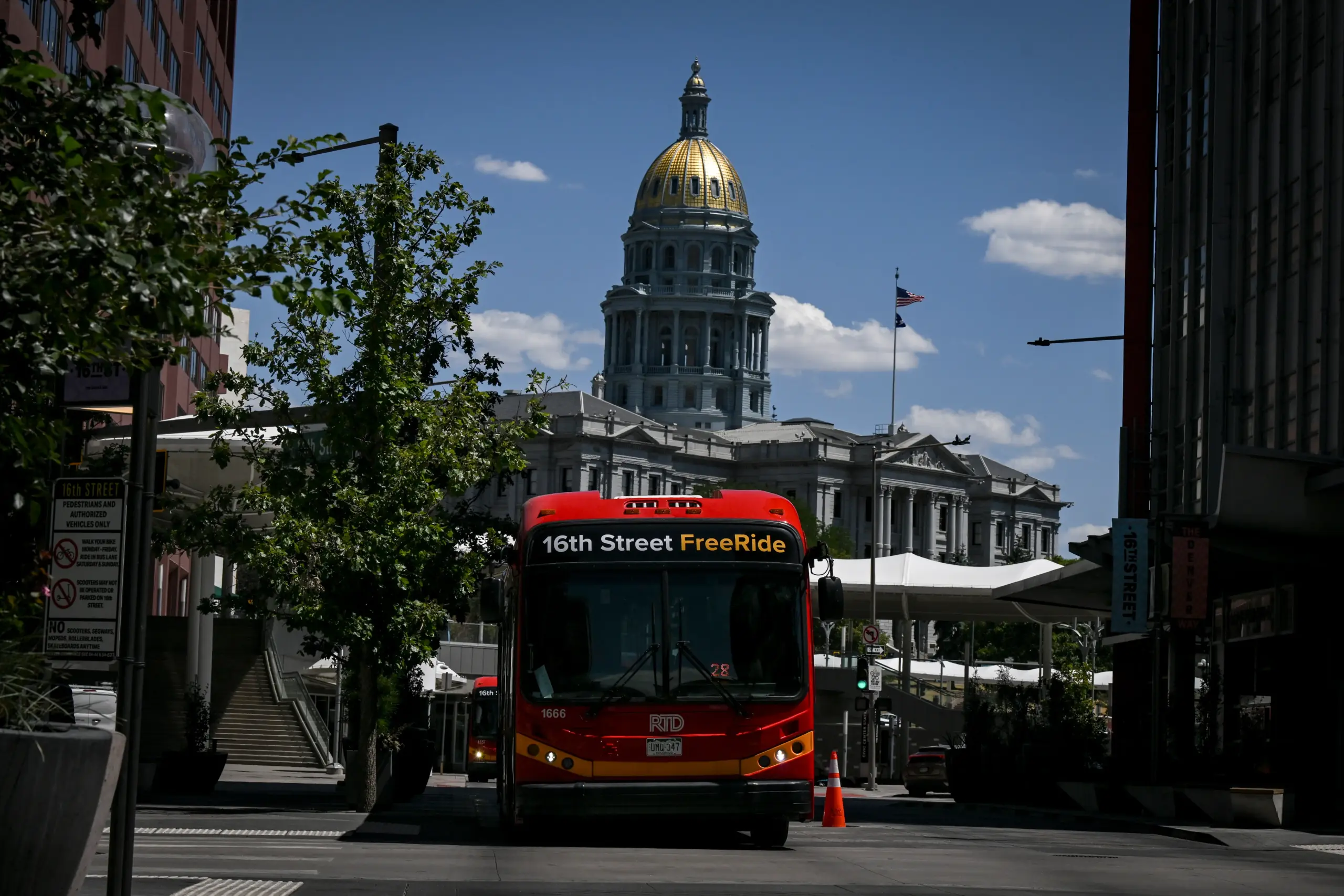
The Regional Transportation District is on the cusp of a significant shake-up, and the upcoming change to the Board of Directors — metro Denver voters will elect five new faces to govern the agency in November — is only one part of it.
Read more Reduce, reuse, recycle snow? That’s one way Aspen hopes to save ski season from climate change.
RTD’s next board will face a laundry list of issues, including grappling with an ongoing deficit, working with a new chief executive officer, cutting routes and possibly pursuing a 2028 ballot measure to increase funding, with only two years to cross them off until a new state law overhauling the governing body kicks in.
Starting in 2029, the 15-member elected board will shrink to nine members, only five of whom will be chosen by voters. The remaining four directors will be appointed by the new governor and confirmed by the state Senate.
But a shorter term and hefty to-do list did not drive away six candidates from vying for three contested board seats this election cycle. Candidates told The Denver Post that the agency’s budget problems, lack of public trust and figuring out how to serve the district’s more than 2,000 square miles and 3 million constituents are all top of mind.
“We’ve bitten off more than we can chew, over and over again,” said Michael Farrington, a Commerce City attorney and candidate for the District K seat.
Farrington pointed to the delay in bringing back BroncosRide as an example, which the Board of Directors this summer voted to restart in August. Days later, RTD officials said the pilot program would be pushed back to 2027 because more planning was needed.
“When you overpromise and overcommit, both financially and publicly, and then under-deliver, people don’t trust you and it’s not going to give us fiscal security on which to build an agency that starts returning ridership,” he said.
Most, but not all, of the candidates said they support funding the Front Range Passenger Rail, a train that will connect Denver to Fort Collins via Westminster, Broomfield, Louisville, Boulder, Longmont and Loveland starting in 2029, pending funding approval from RTD directors. The project would fulfill RTD’s decades-old promise to build a train to Longmont as part of the 2004 FasTracks ballot measure.
Separately, FRPR officials are also asking voters this November to approve Ballot Issue 7A, a sales tax increase to expand the rail line south of Denver, which would add stops in Littleton, Sterling Ranch in Douglas County, Colorado Springs and Pueblo.
District K candidate Jessica Sandgren, a project manager and former Thornton city councilmember, said she does not support RTD funding the Front Range Passenger Rail, “Not even a little bit.”
“I think the conversation for more than 25 years was that high-speed rail was going to come up north and be on the east side of I-25, and it was really only in the last few years that got switched over to the west side of the road and cut all of us out,” she said.
District K residents also live with an unfulfilled FasTracks promise: The N Line, which is supposed to connect Denver’s Union Station with north Adams County near 160th Avenue, currently ends at 124th Avenue, just outside of Northglenn.
“It doesn’t really address any of the problems,” Sandgren said of the Front Range Passenger Rail. “It expands (service) for one specific, small population when we have a much greater need.”
But the never-built train to Boulder County still looms large for residents in the northwest metro and contributes to the public’s lack of trust in RTD, said District O candidate Jack Rosenthal, who works in software engineering.
Meanwhile, RTD directors have talked about asking metro Denver voters for more funding with a 2028 ballot measure as agency staffers work on launching a new, yet-to-be-unveiled system design — and don’t forget the new CEO and board overhaul in 2029.
“Two years is not a long time, but you can get things done,” Rosenthal said, adding he wants to look at “quick win” policies that show the public what RTD is capable of, such as a buddy pass system to award frequent riders with free transit passes for a friend to ride with them.
Audrey DeBarros, also a District O candidate and executive director of Commuting Solutions, said RTD’s finances are a foundational issue. The current board is working on reducing the deficit, she added, but more needs to be done.
“Ultimately we need to create a new vision for transit in the Denver region, and hopefully that’s something voters would be willing to support,” she said. “RTD hasn’t received any new funding in terms of a tax increase from voters for almost 22 years, and the overall system is aging and costing more to operate… We need to be talking about ways we will fund that system.”
But first RTD leaders need to be transparent about issues facing the district and how money is being spent, District B candidate and Denver political strategist Bianka Emerson said.
“Before we go back to the pubic and ask for more resources and dollars, we have to be transparent in what’s going on, how we want to fix those things and show that we’ve been responsible,” she said.
Emerson said she wants to prioritize consistent, on-time routes to increase ridership and revenue and rethink how RTD uses the land it owns, even selling, leasing or developing some of it to meet the Front Range’s need for affordable housing.
District B candidate and Denver architect John Glenn also wants to also look at some alternatives to increase RTD’s revenue. One of the things that motivated him to run for election was seeing acres of underused RTD parking lots on his commute to work from Central Park, and thinking about what the land could be used for instead, like housing and businesses.
That’s a long-term goal, he added, and a 2028 ballot measure could be a bridge to reach it.
“With the affordability crisis permeating all throughout the region, I believe RTD has a role to play in that, and that’s what I want to lead on. We can build more affordable housing, market rate housing, jobs… if we can build all these things to serve the communities at these transit stops, we get more ridership, we get more people, it’s a whole cyclical thing,” he said.
Two new RTD directors are running unopposed this year: Joe Meyer in District C (west Denver) and Coleman Erickson in District J (Westminster and Northglenn.) Incumbent board members Ian Harwick (District L, Arvada and Sherrelwood) and Cindy Arcuri, (District N, west Jefferson County including Ken Caryl and Evergreen) are also unopposed.
Stay up-to-date with Colorado Politics by signing up for our weekly newsletter, The Spot.
Read more Gimmick or giveback? Even some Trump supporters don’t expect to get $5,000 checks after midterms
Read more Most Colorado kids live in areas without enough pediatric healthcare providers