



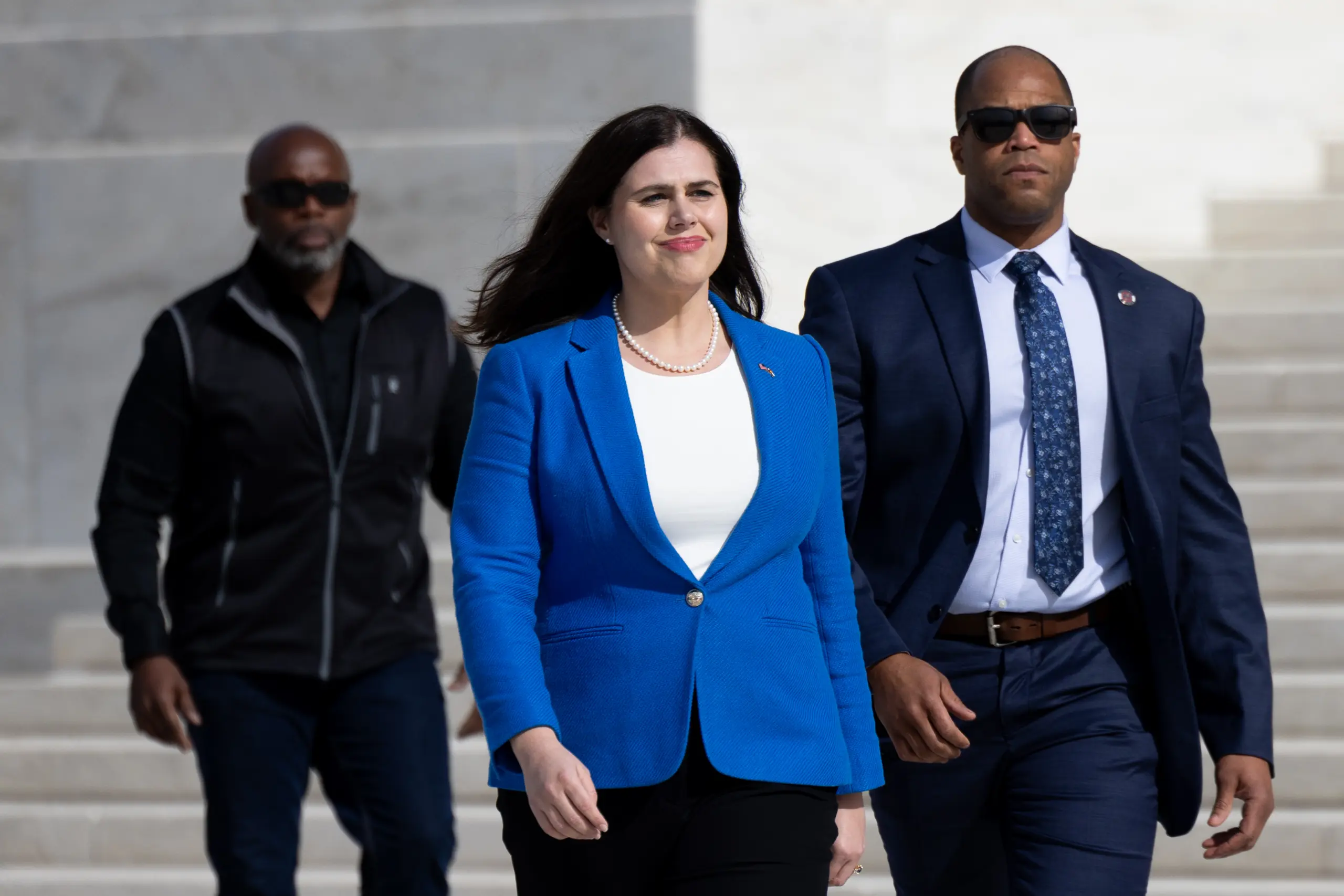
Candidates running to be Colorado’s next secretary of state acknowledge that, for better or worse, the office of the state’s top election official has become more high-profile in recent years.
That’s largely because of greater politicization around the election process — and who is in charge of it — in an era of conspiracies and disinformation. President Donald Trump’s attacks on mail voting and unfounded allegations of widespread election fraud have been met with fierce opposition from Colorado’s current secretary of state, Jena Griswold, who hasn’t shied away from fights with the White House and Republicans when it comes to election integrity.
“It’s a different posture for the secretary’s office to have to take on,” said Matt Crane, the executive director of the Colorado County Clerks Association. “Because you have to now go and communicate so much more, and so much more effectively, about what actually happens in our elections — (and) what doesn’t happen.”
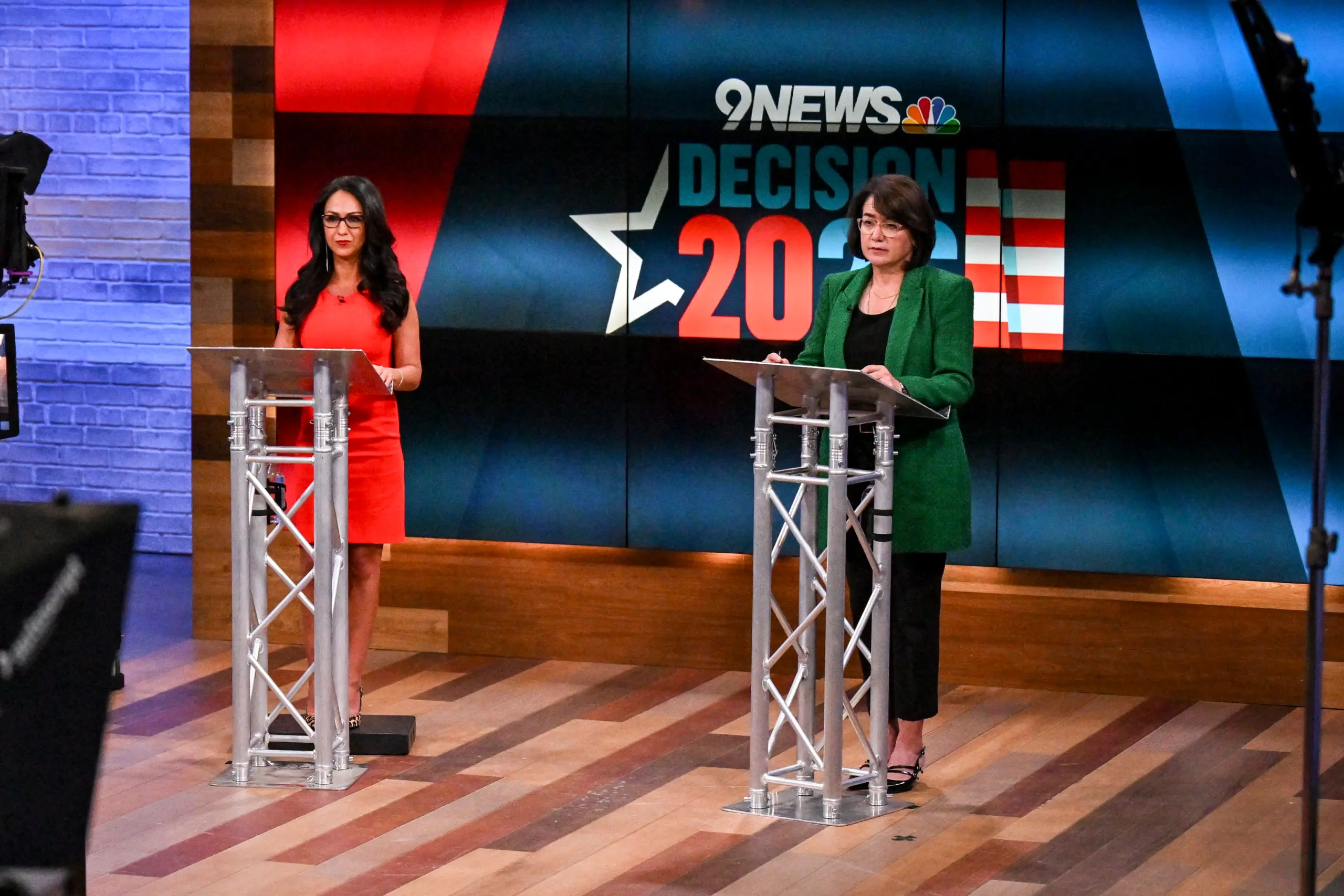
The two major-party candidates running for the office in the Nov. 3 election both say they want to take politics out of the election process.
They differ widely on how to do so.
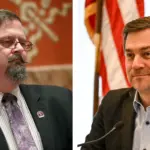
Democratic nominee Amanda Gonzalez, who is finishing a term as clerk and recorder for Jefferson County, says it’s unfortunate that the work of election officials “has gotten painted along partisan lines.”
If elected, Gonzalez, 41, said she would work to quell election conspiracies through transparency and open dialogue about the voting process. She’s also pledged to defend Colorado’s election system, including universal mail voting — something her Republican opponent, James Wiley, says he’d effectively abolish.
Wiley, a former executive director of the Colorado Libertarian Party who’s now running on a major party ticket, is an unabashed election skeptic. He says he’s grown frustrated with what he sees as the politicization of the secretary’s office.
Wiley said he wants to make the role “boring again,” arguing that the office should not be engaging in overtly political fights.
“That’s one of my main purposes: for people to fall asleep listening to me talk, instead of getting fired up,” said Wiley, 32.
Also running for secretary of state this fall is Libertarian Sean Vadney, who secured a last-minute spot on the ballot after the party’s initial candidate, Alex Astley, dropped out. The other third-party candidates are Amanda Campbell with the American Constitution Party and Celeste Landry with the Colorado Forward Party.
Candidates offer starkly different visions
With a budget approaching $50 million, the Colorado Secretary of State’s Office is responsible for myriad tasks ranging from registering new businesses and nonprofits to regulating bingo and raffle operations.
It also serves as the ultimate supervisor of elections for the state’s 64 counties, maintains and updates a voter roll of around 4 million people, enforces voting laws and campaign finance requirements, and verifies signatures for measures seeking to make it onto the ballot.
The work is something Gonzalez says she’s primed for, given her experience overseeing elections for a metro Denver county of about 580,000 people. She was elected clerk in 2022. Before that, Gonzalez, who’s a lawyer, was the head of Colorado Common Cause, a voter advocacy group.
If elected secretary of state, Gonzalez says she wants to simplify TRACER, the office’s database for campaign finance information, with an easier-to-understand public interface. She also wants to continue efforts to expand voting access — pointing to her work on a 2024 state law that requires access to in-person voting at all Colorado jails — and bolster relationships with clerks across the state.
Gonzalez faced flak from Colorado election leaders for trying to start a new clerks’ group focused on metro counties, which critics said would minimize rural voices. Gonzalez said supporting rural clerks and getting them the resources they needed would be a top priority if she were elected to be Colorado’s top election official, adding that she has “great relationships with many clerks throughout the state.”
Gonzalez sees transparency as the key to fighting election skepticism, which is why her Jeffco office offers tours of its ballot-counting facility. And while Gonzalez says she’s always happy to answer questions about elections, she’s prepared to fight efforts to undermine ballot access.
She predicted more attempts by Trump to intervene in state elections after his executive order to restrict mail-in voting for the midterms was temporarily halted last month by the U.S. Supreme Court. Trump, who denies that he lost the 2020 presidential election to Democrat Joe Biden and attempted to overturn the results, has repeatedly claimed, without evidence, that voting by mail has led to mass fraud.
Studies show that voter fraud is exceptionally rare.
“Having questions about how voting works, or how democracy works — that’s healthy,” Gonzalez said. “But if you are just trying to tear it down and insist that something isn’t working, despite the data, that’s something else.”
Wiley is also opposed to attempts by the Trump administration to usurp state officials’ handling of elections, saying it’s not the federal government’s role.
Still, Wiley says he is aligned with the intent of Trump’s executive order, believing Colorado elections are ripe for fraud. He says on his campaign website that he started a tech and marketing consulting firm, but then “the events of 2020 redirected my life into full-time election-integrity work.”
He has called for an audit and potentially for the office to “delete” voter rolls, comments he made in July during an interview on a conservative talk radio show. He now defends the comments as being mostly “hyperbole.”
He believes as many as a quarter of the state’s 4 million registered voters have “anomalies” that could mean they have to reregister to vote, while others may be ineligible to vote and should be removed. Wiley said he got that statistic from ELLY, a database compiled by conservative activists to identify alleged voter fraud.
State and federal laws allow election officials to remove registered voters only for specific reasons. Crane, the clerks association director — and also a fellow Republican — called Wiley’s proposal “not legal” and “stunningly stupid.”
Wiley said he would operate within the law and not remove eligible voters.
Wiley, who said he doubted the results of the 2020 and 2000 presidential elections — and “probably every election in between” — also said he wanted all ballots counted by hand, as opposed to machines — which he doesn’t believe are secure, especially amid the rise of artificial intelligence.
He has called for a reversal of Colorado’s move to mail voting. He wants Election Day to become a state holiday — and, ideally, a national holiday — so that voters can get time off work to stand in line at polling centers, though he would still support absentee ballots for people who can’t make it in person for various reasons.
But Wiley does not see his proposals as radical overhauls. He calls it “a reset to a time when things were simpler, when things were better understood, and when more people participated in the process and, therefore, the trust was at a higher level.”
How political should the job be?
Crane said whoever becomes Colorado’s next secretary of state must be prepared to navigate a tumultuous time for elections.
But, he added, “the goal should always be to approach that conversation in such a way to where you aren’t undermining confidence from one group of voters versus another.”
Griswold — a Democrat first elected in 2018 who is term-limited and running for attorney general in November — has taken a gloves-off approach.
Griswold frequently appears on national news networks to denounce attacks by Trump and his allies over mail voting. She touts her role in pursuing legal action against former Mesa County Clerk Tina Peters for giving unauthorized access to voting systems in a bid to prove election fraud after the 2020 election. (Peters was released from prison earlier this year by Gov. Jared Polis, who commuted her sentence.)
Griswold also supported a failed effort to keep Trump, who she has called an “insurrectionist,” off the ballot in 2024.
But Griswold’s posture has made her a target of Republican critics who say she has politicized the office.
Crane said the next secretary of state should stand up to efforts to undermine election integrity, while cautioning the new official to be measured in how — and when — they engage in political fights.
“Not everything that gets said needs a response. There’s not always a need to throw gasoline on a fire,” he said.
While Wiley believes the secretary of state’s office has been “weaponized” and used as a “political tool,” Gonzalez said the role is to uphold election laws and protect the right to vote.
“And I don’t think that that is a partisan statement,” she said. “If Donald Trump thinks that is a partisan statement, if somebody in a different party thinks that that is a partisan statement, then I don’t really know what to tell them. That is a fair democracy.”
Gonzalez has maintained a major cash advantage over Wiley, raising $345,649 to Wiley’s $69,289, according to the most recent campaign finance reports. Gonzalez had $115,232 in cash on hand, while Wiley’s campaign had $7,798 in debt.
Stay up-to-date with Colorado Politics by signing up for our weekly newsletter, The Spot.
Read more CU turns it over four times in second half, Buffs fall to No. 12 Texas Tech