








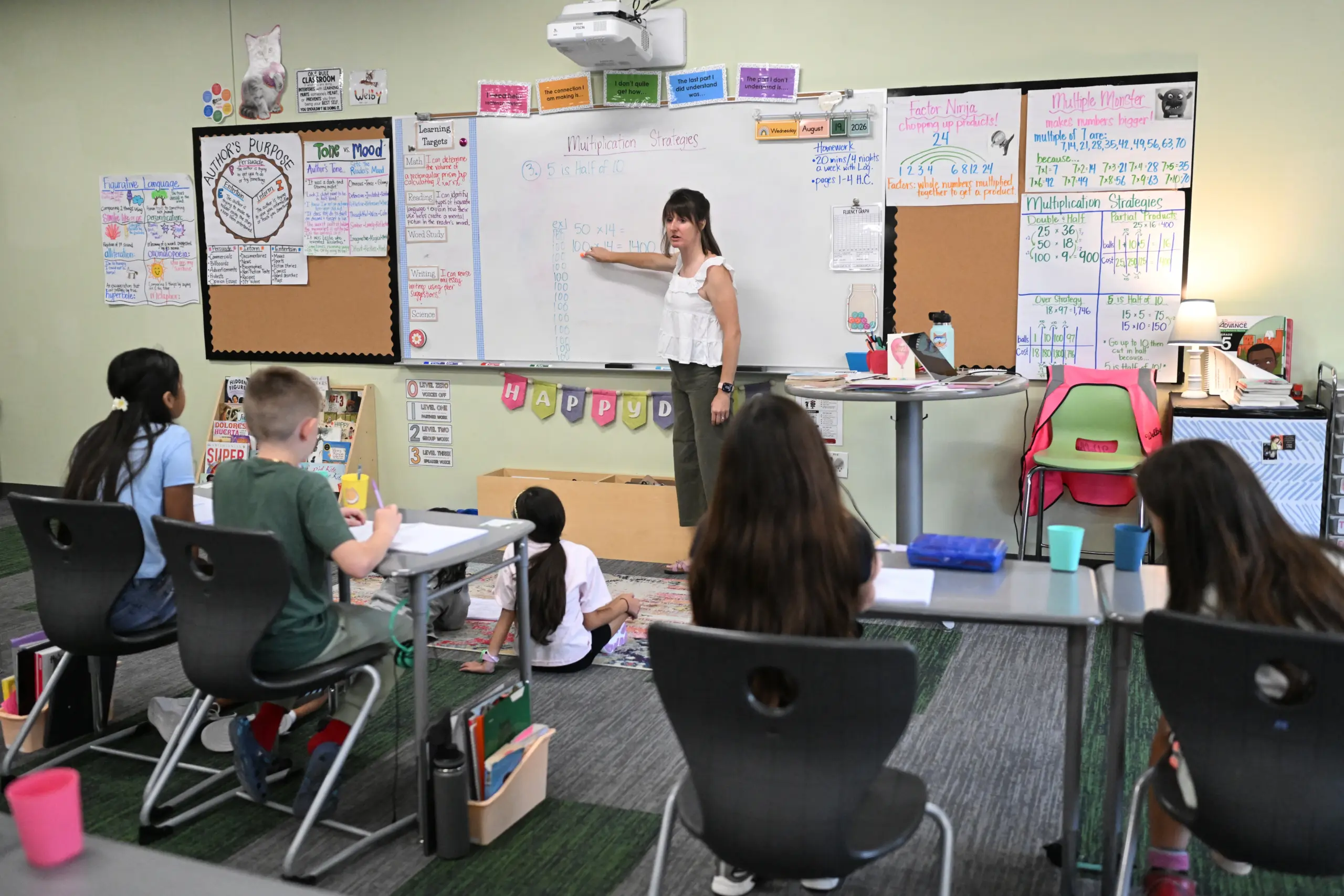
Language arts proficiency rates dropped for half of the grades that took Colorado’s latest statewide achievement tests, while rates in mathematics held steady or increased, according to 2026 results released Wednesday.
Read more Flock Homes moving Denver headquarters downtown, shrinking office footprint
The state administers annual tests in language arts and math, known as the Colorado Measures of Academic Success, to students in third through eighth grade annually. It also offers versions of the PSAT and SAT to assess high school students’ performance.
Only students in fifth, eighth and 11th grades take a science exam. Proficiency dropped in fifth grade, while decreases among older students didn’t reach significance, which the Colorado Department of Education defines as 1.5 percentage points.
The state administered social studies tests for the first time this year. In fourth grade, 25.6% of students met expectations, while 36.6% of seventh graders did.
In high school, the share of students meeting expectations on the PSAT in 10th grade improved slightly for both math and language arts. Ninth graders improved in math and held steady in language arts, while a smaller percentage of 11th graders met the reading and writing standard on the SAT.
Interestingly, high school students were more likely to meet expectations on the PSAT or SAT than younger students were on the state tests. That probably reflects that the version of the PSAT and SAT they take involves multiple-choice questions, while CMAS requires students to write out answers, said Christina Wirth-Hawkins, chief assessment officer at the Colorado Department of Education.
The share of students statewide who met or exceeded expectations for their grade level in language arts increased in grades four and five, but was essentially flat in third grade and dropped in the middle school years. The share meeting that standard ranged from a low of 40.8% in third grade to a high of 49.9% in fifth grade.
The statewide progress in fourth and fifth grade language arts suggests that efforts to help struggling readers are at least partially successful, with today’s fifth-graders significantly more likely to meet or exceed grade-level expectations than they were in third grade, Wirth-Hawkins said. Efforts to focus on literacy in kindergarten through second grade and to assess students’ abilities in those early years may have helped better prepare children when they hit third grade and started taking the state tests, she said.
In contrast, math proficiency rose by a margin the Department of Education deemed significant for fourth and eighth graders compared to 2025. The other tested grades’ rates of meeting and exceeding expectations also moved in a positive direction, but the changes didn’t rise to the level of significance.
Math proficiency was still lower, however, ranging from 32.7% in sixth grade to 41.5% in third grade.
In 2025, students also demonstrated greater growth in math than in language arts. Interestingly, however, what improvement there was in reading and writing mostly showed up in middle school, with relatively flat scores for younger students, according to Chalkbeat.
Colorado Education Commissioner Susana Córdova said the results showed opportunities for improvement, but cautioned against alarmist interpretations. While fewer than half of kids met or exceeded expectations in language arts, another roughly 25% fell in the “approached expectations” category. Kids in that category can read at grade level, but may struggle with more complex texts or produce less-sophisticated answers, she said.
“We have very rigorous state standards,” she said.
Statewide, disparities between ethnic groups and between students living in poverty and those with more resources were similar to previous years, suggesting that kids who start with more challenges aren’t getting the help they need to catch up, Wirth-Hawkins said.
‘Where we see the results’
Multiple districts in the Denver area followed the statewide pattern.
In the Douglas County School District, the share of students proficient in language arts and math both trended upward, though only the math result reached significance. Districtwide, 63.8% met expectations for language arts, and 57.2% did for math.
“Math was a specific bright spot for us, with the greatest growth occurring in that subject area, and we are incredibly proud of the work that our students and staff have done to advance achievement in this area,” district spokeswoman Paula Hans said in a statement.
Read more Driver in fatal Aurora hit-and-run turned himself in, police say
In Denver Public Schools, 42.5% of students met or exceeded expectations in language arts, and 35% did in math. The share of students proficient in math increased compared to 2025, while a small bump in language arts proficiency wasn’t statistically significant.
Superintendent Alex Marrero said the improvement in math performance reflects the district’s decision to focus there, including by hiring a math teaching specialist. Other tests are showing progress in reading among kids from kindergarten through second grade, which should start to show up in improved CMAS scores next year, he said.
“What we put our energy behind is usually where we see the results,” he said.
Achievement gaps between racial and ethnic groups also narrowed for students in early elementary school and high school, with Black and Hispanic students posting faster growth in test scores, Marrero said. Students in the middle years haven’t seen the same benefit, though, possibly because of challenges in their first school experiences, he said.
“This is the group who has been most impacted by the pandemic,” Marrero said.
A national sample of 9- and 13-year-olds found gains in reading and math for the younger children in late 2024 and early 2025, but stagnant performance for the middle schoolers. Experts told NPR that lingering effects of the pandemic might be a factor, because schools were operating normally by the time younger students arrived.
Cherry Creek Schools reported the strongest growth among students in the middle grades, however, with fourth-graders making the most progress in language arts and eighth-graders taking the lead in math. Across all grades, 49.5% met or exceeded expectations in language arts, as did 44.2% in math.
“We are especially encouraged by the growth we are seeing in English language arts and are hopeful that these positive growth trends will continue to translate into increased student achievement,” interim Superintendent Jennifer Perry said in a statement. “At the same time, we know there is more work to do to raise achievement levels for all students and eliminate gaps.”
Bucking statewide trends
Unlike the state as a whole, Sheridan School District 2 saw a drop in proficiency in both language arts and math, with the shares of students meeting expectations dropping to 7.4% and 3.7%, respectively.
The district went through an 18-day teachers strike this spring, and those “extraordinary instructional circumstances” worked against students, director of community and media engagement Breanna Deidel said in a statement.
In the coming school year, the district plans to use targeted assessments to find out where students need additional support and to work on accelerating learning so those who “approached expectations” in 2026 can meet them in 2027, she said.
“The district is approaching the spring 2026 assessment results as both an accountability measure and a baseline for academic recovery,” she said. “State assessments represent student performance at a specific point in time. For Sheridan students, that point in time followed a year in which 18 instructional days were disrupted by the educator strike.”
Mapleton Public Schools bucked the statewide trend in the opposite direction by increasing proficiency in both language arts and math, though its rates remained below the state average, with 27.7% meeting or exceeding expectations in language arts and 20.3% doing so in math.
Superintendent Mike Crawford said efforts the district began during the pandemic are starting to yield results. The process involved a year “grounding” teachers in the state standards, another focused on best practices for lesson planning, and a third developing a system of supervision to help teachers do their best work, he said.
“Real improvement in student outcomes takes time,” he said.
Now, the district is focusing on assessing students’ performance more frequently so teachers know what concepts they need to spend more time on and schools can see weak spots where they can direct professional development, Crawford said. But they’re also continuing to work on school culture, so kids feel welcome and safe while grappling with challenges, he said.
“A student has to feel like they matter to a teacher — especially a young student — before they do their best work,” Crawford said.
Read more Moderna shares surge after it says its experimental mRNA cancer treatment passed a key test
Share of students meeting or exceeding expectations in language arts statewide
- Grade 3: 40.8%, down 1.2 percentage points
- Grade 4: 47.0%, up 5
- Grade 5: 49.9%, up 1.9
- Grade 6: 41.6%, down 2.6
- Grade 7: 46.6%, down 2.2
- Grade 8: 42.2%, down 1.7
Share of students meeting or exceeding expectations in math statewide
- Grade 3: 41.5%, up 0.3 percentage points
- Grade 4: 39.0%, up 2.5
- Grade 5: 39.3%, up 0.2
- Grade 6: 32.7%, up 1.3
- Grade 7: 32.9%, up 1.1
- Grade 8: 37.8%, up 3.1
Share of students meeting expectations on the PSAT or SAT in reading and writing
- Grade 9: 65.6%, up 0.2 percentage points
- Grade 10: 65.1%, up 1.6
- Grade 11: 59.6%, down 1.9
Share of students meeting expectations on the PSAT or SAT in math
- Grade 9: 40.5%, up 3.0 percentage points
- Grade 10: 38.9%, up 2.5
- Grade 11: 31.6%, down 0.9
Denver-area school districts by share of students meeting or exceeding expectations in language arts
- Boulder Valley School District: 65.3%
- Douglas County School District: 63.8%
- Littleton Public Schools: 62.1%
- Jeffco Public Schools: 53.7%
- St. Vrain Valley School District: 51%
- Cherry Creek Schools: 49.5%
- Denver Public Schools: 42.5%
- Adams 12 Five Star Schools: 42.3%
- Englewood Schools: 31.0%
- Mapleton Public Schools: 27.7%
- Aurora Public Schools: 26.1%
- Westminster Public Schools: 24.0%
- Adams County School District 14: 15.4%
- Sheridan School District 2: 7.4%
Denver-area school districts by share of students meeting or exceeding expectations in math
- Littleton Public Schools: 58.4%
- Douglas County School District: 57.2%
- Boulder Valley School District: 56.1%
- St. Vrain Valley School District: 46.9%
- Jeffco Public Schools: 44.6%
- Cherry Creek Schools: 44.2%
- Adams 12 Five Star Schools: 35.5%
- Denver Public Schools: 35.0%
- Englewood Schools: 26.7%
- Aurora Public Schools: 20.5%
- Mapleton Public Schools: 20.3%
- Westminster Public Schools: 17.6%
- Adams County School District 14: 10.9%
- Sheridan School District 2: 3.7%
Source: Colorado Department of Education
Get more Colorado news by signing up for our Mile High Roundup email newsletter.