







Colorado has invested $70 million in modular and off-site home manufacturers, part of a larger effort to alleviate the state’s shortfall of affordable housing.
Read more More than half of House Democrats vote to cut Israel aid in growing split
But when Clayton Homes announced in December that it was shutting down the state’s largest modular manufacturing plant, located in Adams County, it raised a critical question.
If Clayton, the nation’s leading manufactured homebuilder, couldn’t justify operating in Colorado, what are the survival odds for the 18 newer and much smaller home-construction innovators the state has backed in recent years?
Before the housing crash in the late 2000s, Colorado was home to a half-dozen modular factories. Clayton’s Heibar facility, formerly known as Precision Building Systems, part of Oakwood Homes, was the last of that generation to finally call it quits.
Enter Vederra Modular, which is trying to fill the void, to the point of acquiring equipment and hiring some of the workers let go last year by Clayton’s Heibar Installation plant.
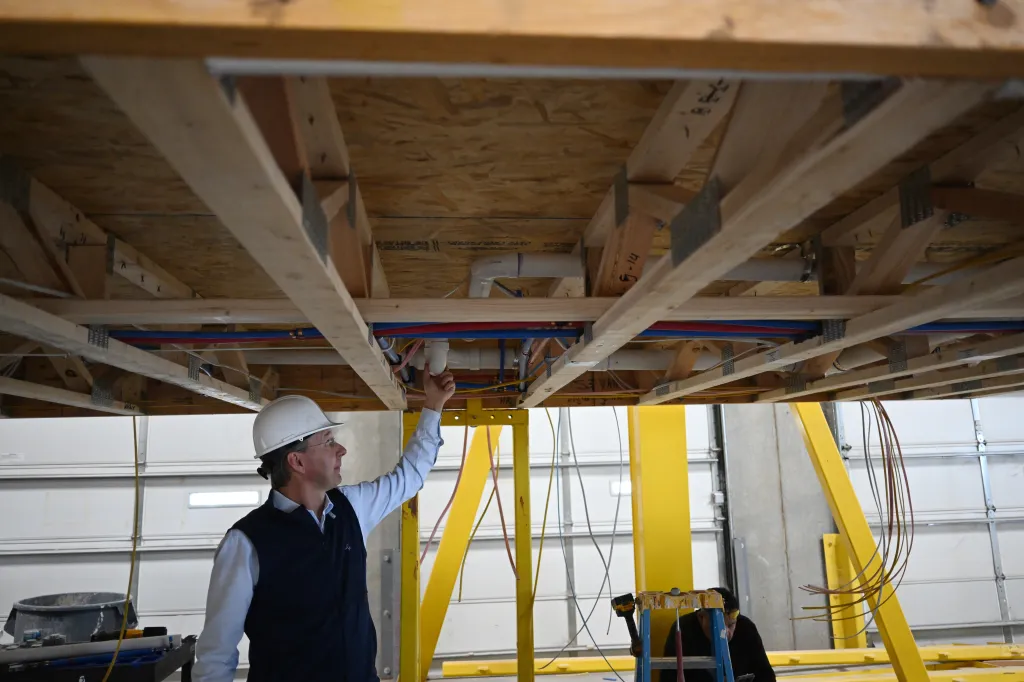
Vederra’s 140,000-square-foot facility in Aurora is two-thirds the size of the shuttered Heibar plant. And the company says it has co-developed a proprietary model to create factory-built homes and apartments at a significantly lower cost.
Founder Nathan Peterson, who has spent 25 years in the modular industry, pointed with pride during a factory tour on the equipment deals he managed to land, some at pennies on the dollar.
He is leasing space rather than buying land for the factory. He has avoided investing heavily in robotics, in part because he lacks the money, but also because it would create a burdensome overhead when work orders slow.
Silicon Valley tried to address the inefficiencies in the home construction industry through a startup called Katerra, which deployed advanced robotics and software throughout.
Katerra was a private equity darling until it burned through $2.4 billion in six years before abruptly liquidating in June 2021. Its sudden failure left two Denver apartment buildings and a hotel in limbo, although all three were eventually completed.
Equity investors and unsecured creditors weren’t so fortunate.
Vederra Modular, by contrast, represents a bootstrap venture, one that is relying heavily on state support but also finding a way to lower costs.
In 2024, the state extended $2.5 million in cash collateral support via the Innovative Housing Incentive Program, through Colorado’s economic development office, and $3.5 million in working capital from the state’s Proposition 123 Affordable Housing Financing Fund, administered by the Colorado Housing and Finance Authority.
Peterson acknowledged his factory wouldn’t have gotten off the ground without state funds, which have some strings attached — the creation of 150 local jobs and 316 affordable housing units a year.
“Vederra is one of a growing number of Colorado companies developing innovative new off-site construction methods such as modular, panelization, 3D printing, foundation and framing kits, and composite wood technologies,” said Hilary Cooper, director of Innovative Funding for Housing Programs at the Colorado Office of Economic Development and International Trade.
Rather than betting big on one technology or a couple of companies, the state has spread its wagers across 18 housing innovators in 12 counties. The target they have set is the construction of 7,000 housing units a year, which would represent a sizeable chunk of the 35,000 or so building permits pulled in the state in 2024.
Over time, the hope is that innovation can shrink the state’s shortfall, which the State Demography Office estimated last fall at 106,000 homes and apartments.
“By helping these companies launch and grow, we can help more Coloradans live close to their jobs, and in communities they love,” Cooper said.
Modular construction involves building components, such as walls or trusses, or entire structures, inside a factory, rather than on the home site. Assembly lines can run day and night, protected from the elements, making for a more efficient and attractive work environment. Quality control is easier to maintain, and waste is much lower.
Completed components ship to the home site, where they are assembled or put on a foundation. Modular construction promises lower costs, higher quality and much faster completion time. But factories need a steady flow of orders to support their overhead, and that went away after orders dried up during the housing crash in the late 2000s.
Workforce housing in the mountains
With the Front Range currently facing a glut of apartments, Vederra Modular has zeroed in on the affordable housing market in resort communities where the shortfall remains acute.
The approach of building energy-efficient modules in a factory, while the land is prepared, aligns better with the short building season faced in mountain communities, said Paul Capps, president of Summit Housing Group in Missoula, Mont.
Summit Housing and the town of Granby are currently developing a 66-unit project called the Summit at Granby Apartments for people earning between 30% and 60% of the area median income in Grand County. That would likely put rents in the range of $600 to $1,200 a month for a two-bedroom unit based on the AMI.
They are also developing a related 75-unit workforce housing development within Nuche Village, which targets workers making 80% to 120% of the area’s median income.
Summit expects to close on its construction loans within the next 30 days, at which point it will give Vederra Modular the go-ahead to start assembling modules.
“We hope that the boxes can be built and shipped up there by November of this year before it gets too cold,” Capps said.
Time is money when it comes to construction. Each month of delay will cost Summit $100,000 in interest payments on its construction loans, he said.
Having apartments completed and occupied in one year rather than in two or three years could save Summit Housing between $1.2 million and $2.4 million in financing costs, he estimates.
Modules currently take about three weeks to build, Peterson said, and the company is working on a real-time labor management software called Vederra OS to keep the assembly line flowing more smoothly by reducing the idle time of workers.
Savings in the void
One of the key innovations developed by Peterson, in partnership with Dean Dalvett, owner of EV Studios in Denver, is a construction method known as Alt-Mod.
Traditional modular designs contain complete walls and floors ready to be shipped to the construction site. That allows boxes, which can contain a full room or a room and parts of other rooms, to be more easily stacked on top of or next to each other.
However, the convenience in assembly comes with a trade-off: overbuilt walls and floors and wasted construction materials.
Vederra’s method, which will be tested in Granby, only builds enough of the walls and floors to interlock with other modules.
“We intentionally leave a void space,” Peterson said. “That cuts the number of boxes needed in half.”
The approach involves more finishing work onsite, but it saves between 15% to 20% over traditional modular methods, according to EV Studios.
For The Summit at Granby, a traditional modular approach would require 93 boxes with a component cost estimated at $13.7 million. The Alt-Mod method reduces the box count to 47 and brings the component costs to $9.4 million.
The system, however, does require more on-site labor to complete the unfinished spaces. Those costs rise to $1.93 million versus $581,000.
All in, the Summit at Granby carries a price tag of $18.7 million versus $22.6 million using more traditional modular methods, a savings of 17%.
Rodger Hara, an affordable housing industry consultant, said better economies of scale mean more affordable homes can be built.
Vederra and EV Studios appear to have made a promising breakthrough in that regard, he added.
Capps said lower costs can make the difference between an affordable project winning tax credits and getting completed or staying on the drawing board. And that can make the difference between workers in a community having a place to lay their heads near where jobs are or having to make long commutes on icy roads.
“The Alt-Mod program is a cost-saver and a game-changer in the affordable housing space,” he said.
Emergency housing on the go
Another innovation that Vederra is working on involves moveable “pop-up” factories that can be brought into disaster areas or into remote areas without homebuilders.
Vederra Onsite is developing a system to quickly set up 60,000-square-foot factories capable of producing 350 homes a year in areas where the housing stock has been destroyed or isn’t keeping up.
The idea is to put factories close to where homes are needed, whether it is a hurricane-scoured Gulf Coast community or a fire-scorched mountain town. As an added benefit, the factories could provide 50 to 75 jobs to residents who might otherwise be unemployed after a natural disaster.
Factories could also be set up in isolated places with acute housing shortages, like North Dakota’s Williston Basin experienced during the shale oil boom from 2006 to 2014.
Peterson said the Colorado Department of Local Affairs is funding a pilot plant. He is working to get the Federal Emergency Management Agency interested.
“We are trying to take one to Hawaii,” he said.
A catastrophic wildfire in August 2023 killed 102 residents of Lahaina in Maui and destroyed about 1,900 homes and apartments. Nearly three years later, only 231 replacement homes have been completed, with building permits issued for another 549, according to a County of Maui Recovery Dashboard.
In January, Colorado extended a $1 million line of credit through Proposition 123 and a $1.8 million loan through the Innovative Housing Incentive Program for a pilot project to assemble the first pop-up factory.
After the homes are built, the factories can then be packed up and moved to the next crisis zone as needed, Peterson said.
Get more real estate and business news by signing up for our weekly newsletter, On the Block.
Read more What to know about eating at home and dining out during the cyclospora outbreak