



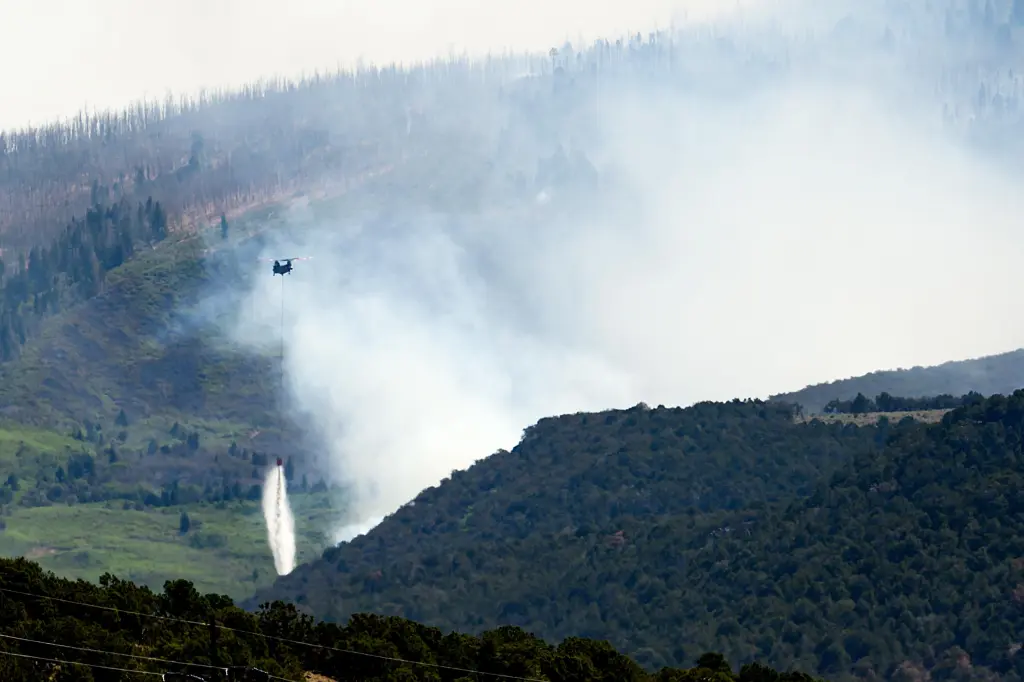
Three firefighters died and two were injured after being overtaken by flames while battling a nearly 30,000-acre wildfire in western Colorado near the Utah border, federal officials reported Sunday.
U.S. Wildland Fire Service — created earlier this year to streamline firefighting and fire reduction across public lands — said the five federal firefighters had been part of an interagency response to the Knowles and Gore fires on the Western Slope on Saturday.
“The U.S. Wildland Fire Service stands united with the USDA Forest Service in grief and in our unwavering support for the loved ones left behind. Their bravery, dedication and sacrifice will never be forgotten,” the agency said in a statement on Facebook.
The firefighters were caught in a “burnover incident” and deployed their fire shelters, U.S. Forest Service officials said. A burnover is when a wildfire overtakes firefighters or their equipment, leaving them no time to escape.
The identities of the U.S. Wildland Fire Service and U.S. Forest Service firefighters have not been released.
Colorado Gov. Jared Polis declared a disaster emergency on Saturday and authorized the use of the National Guard to fight the fires.
Eastern Utah firefighters first responded to two new wildfires — the Snyder Mesa and Jones fires — Saturday morning, according to the Moab Valley Fire Department.
The two fires quickly spread into Colorado’s Mesa County and merged into one, consuming the small Knowles and Gore fires already burning on the Western Slope and scorching a combined 28,000 acres, according to the Colorado governor’s office.
“I’m devastated about the loss of three heroic firefighters who died in the line of duty in Western Colorado,” Polis said in a statement. “The men and women who serve on the front lines of these fires risk their lives to keep us safe and to protect the lands and communities we love. To the loved ones of those lost, and to their fellow crew members — some who are still battling the flames –know that the State of Colorado mourns alongside you.”
Colorado officials are working closely with the Bureau of Land Management and local agencies “to deploy any and all resources needed to fight these fires… and to recover the three firefighters who were lost,” Polis said.
The Mesa County Sheriff’s Office and the American Red Cross opened a Snyder Mesa fire evacuation center at the former Faith Heights Church, 600 28¼ Road, in Grand Junction.
The sheriff’s office issued pre-evacuation notices to residents living in the Glade Park area, the Kingsview subdivision and the Pollock Canyon Estates, according to a Facebook post. That includes the area south of the Colorado River to BS Road and west of Colorado 340. The sheriff also closed A 2/10 Road at DS Road and BS Road before the Bureau of Land Management boundary, according to a Facebook post.
The wildfire was sending waves of smoke across Colorado on Sunday, prompting state health officials to issue an air quality advisory for most of the western state.
“Areas near and downwind of large fires in southwestern Colorado and southeastern Utah could have periods of moderate to heavy smoke through at least Monday morning,” an alert from the Colorado Department of Public Health and Environment stated.
The air quality alert will remain in effect until at least 9 a.m. Monday and covers Chaffee, Clear Creek, Delta, Dolores, Eagle, Garfield, Gilpin, Grand, Gunnison, Jackson, Lake, Mesa, Montezuma, Moffat, Montrose, Ouray, Park, Pitkin, Rio Blanco, Routt, San Miguel and Summit counties. If visibility drops to less than five miles, the smoke has reached unhealthy levels, state officials said.
Wildfire activity has intensified across the western United States, as consecutive days of hot, dry and windy weather have fueled flames in Utah, Arizona and elsewhere, with new fires popping up across the region.
The largest blaze, the Cottonwood fire, was burning in rugged terrain in southwest Utah. It ballooned Saturday to more than 144 square miles (373 square kilometers) after marching through canyons and mountainsides, destroying part of a ski resort and other summer cabins along the way.
Read more Billionaire ranch owner’s fence is harming wildlife in a southern Colorado valley, experts find
Authorities in Beaver County began working with fire teams on Saturday to assess the extent of the damage, but no estimates were immediately available. Utah Gov. Spencer Cox called it bleak in a post on social media, but he thanked crews for what he called “several miraculous stops and saves.”
The cliffs and steep slopes have made the job even harder, said Alyssa Mason, a spokesperson assigned to the fire.
“It’s hard to get dozers and other heavy equipment into that. It’s hard to get engines into that,” she said. “It doesn’t make it impossible to firefight, but it does just kind of slow things down.”
Hundreds of firefighters have been arriving in the arid state to battle new starts as well as those that have been growing because of what forecasters called critical fire weather — dangerously low humidity levels, warm temperatures and gusty winds.
The danger is even higher this year because of Utah’s record-low snowpack and its warmest winter on record. Much of the West is grappling with similar conditions, according to .
From Alaska to Florida, crews worked Saturday to corral dozens of fires, including three dozen that were classified as large and uncontained.
Nationally, nearly 3 million acres (1.2 million hectares) have burned since the start of the year. That is more than the 10-year average.
The conditions in Utah were critical enough for Gov. Cox to declare an emergency earlier this week and clear the way for the state to ban fireworks ahead of the July Fourth holiday. The order comes as Utah is experiencing one of the most severe wildfire seasons in recent history, fueled by historic drought conditions.
State officials said that over the past week, Utah has seen an increase in wildfire starts, with each fire showing unprecedented behavior. These starts have stretched the state’s wildland firefighting capabilities, State Forester Jamie Barnes said.
Forecasters with the National Weather Service over recent days have been issuing red flag warnings for a wide swath of the West, from California to Arizona and New Mexico.
South of Grand Canyon National Park, authorities said the flames of a new wildfire were moving away from Grand Canyon Village and the nearby community of Tusayan on Saturday. But about 50 miles (80 kilometers) away, another fire prompted Coconino County officials to issue evacuation orders for those near Kendrick Mountain.
Parts of northern Arizona were without power Saturday as the utility serving the area initiated a safety shut-off in hopes of lessening the wildfire risk.
Power shutoffs have become more common in the West as wildfire risk has expanded. It is usually a last resort after utility forecasters weigh factors like sustained wind and gust speeds, available fuels and topography.
With extreme fire conditions persisting in Utah, Rocky Mountain Power also shut off power lines serving Beaver County and other areas.
Get more Colorado news by signing up for our daily Your Morning Dozen email newsletter.
Read more Today in History: June 28, police raid at Stonewall Inn sparks gay rights movement