




To jumpstart his transformation into one of Colorado’s best high school baseball players, Cory Dean Carver made his own brand.
The Montezuma-Cortez senior shortstop was 10 years old when he decided that he wanted to chase his baseball dream beyond the state’s southwestern corner. But expanding his skills outside his small town of Cortez, which has approximately 9,000 residents and little opportunity for competitive baseball, meant a serious commitment to traveling. And that necessitated a stack of cash each summer to fuel that dream.
So the then-fifth-grader worked for his family’s hay and cattle company, getting up at dawn to irrigate, mend fences, and feed cows in the morning and at night. Carver was in charge of some of those cows that roamed the 50,000 acres the family leases from the government, and they had Carver’s brand on them; the family would sell the bulls in the springtime to help pay for his baseball.
“That’s really when my competitive career started out,” Carver said. “It was a lot of labor on the farm (to fund it). I would drive around machinery like tractors or skid steers to do it, and every day would load and unload bales of hay for all the cows to eat.
“The number one thing all that taught me was diligence. A lot of the times I’d wake up around 6 o’clock in the morning, thinking ‘I really don’t want to do this, this sucks, I hate this,’ but I’d get up and go anyways. It taught me diligence and being able to wake up every day and work hard to get what I wanted, and that translated to my baseball career, school, everything.”
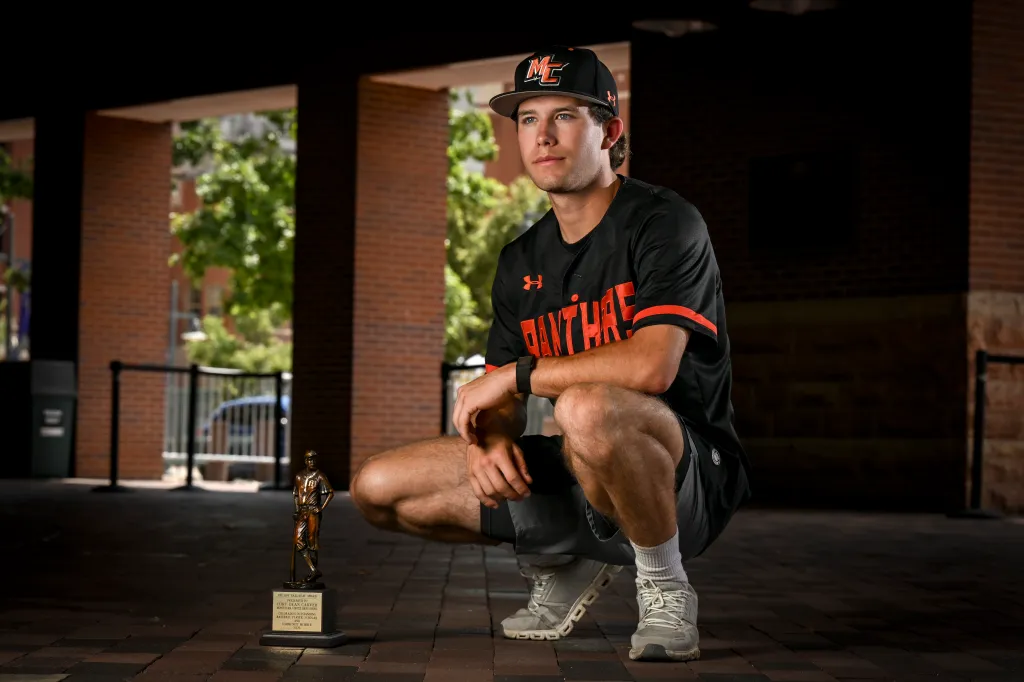
Considering that genesis, it’s no surprise that Carver is the winner of The Denver Post’s 2026 Roy Halladay Award, presented annually to the top senior baseball player, scholar and community member in Colorado.
Hits, grades, giveback
The Naval Academy signee dominated on the field, batting .580 with 46 RBIs, 13 doubles, four triples, seven homers, a .649 on-base percentage and 21 steals this year. For his career, Carver hit .501 with 127 RBIs, 49 doubles, 21 triples, 18 homers and 105 steals.
Off the diamond, the 18-year-old was equally as impressive to win the second annual Halladay Award. Carver carried a 4.26 GPA, and his community service resume included four years as a volunteer youth baseball coach, volunteering for fundraisers at Pleasant View Elementary, and volunteering at a local assisted living facility where he played piano for residents, did yard work and cleaned the exterior of the building.
In a vote by the Halladay Award’s 15-member section committee, Carver’s well-rounded body of work edged runner-up Hudson Alpert, a star right-hander at Regis Jesuit, as well as three other impressive finalists in Falcon right-hander/first baseman/outfielder Aaron Jaquez, Durango corner infielder/pitcher Austin Romero and Grandview right-hander Ethan Wachsmann.
For winning the award, Carver gets a trophy, a $1,000 scholarship from the nonprofit Colorado High School Baseball Player Award Corporation, a banquet held in his honor and recognition at Monday’s Rockies-Red Sox game at Coors Field.
“This means so much to me,” Carver said of winning the award named after the former Arvada West great and National Baseball Hall of Famer. “I’m honored, and it honestly came as a shock when I got the call that I won. (Getting an award) was never the motivation to do well in school or give back to my community, but I’m grateful to be recognized.”
Carver, a three-time Intermountain League Player of the Year, led the Panthers to the Class 3A state tournament this season and earned CHSAA first-team all-state for his play. He’s a hard-nosed, old-school type of player who refuses to let his smaller frame — 5-foot-8, 150 pounds — define him.
With a game modeled after former Red Sox second baseman and American League MVP Dustin Pedroia, one teammate describes his approach to baseball as “all gas, no brakes.”
“He’s not afraid to get on a teammate in the dugout if they need it,” said close friend Jonah Castle, Carver’s longtime club teammate. “He’s not afraid to chew someone out because they’re not doing something right or they’re lacking effort. He just wants to bring the best out of everybody, and that’s what he does. But most of that is led by example.”
A three-state, four-pro journey
Carver’s journey from Cortez to Annapolis was shaped by four former professional players over significant time spent in three different states.
In Cortez, Carver had Jake Huff, who coached him in recreational Southwest Colorado Youth Baseball, and then became the shortstop’s head coach at Montezuma-Cortez the last three seasons. Huff played a couple of seasons in the Padres’ organization, reaching as high as Double-A.
Carver’s coaching circle also featured Adam Morrissey, his trainer in Farmington, New Mexico, who played 10 minor-league seasons for four different organizations, reaching Triple-A; Tim Olson, who played for the Diamondbacks and Rockies and helmed Carver’s Slammers team in Denver; and Brian Harper, a 16-year big-league veteran and 1991 World Series champion with the Twins who coached Carver’s club teams in Phoenix, Ariz.
“Having all of us as coaches was extremely valuable to Cory because he’d take bits and pieces from each of us, and from all these former pros he formed his own way of playing the game,” Jake Huff said. “The fact that Cory can make adjustments or bounce something off one coach and another coach to come up with a solution or a result that he desires just speaks volumes about him being a coachable kid.”
With those former pros overseeing his development — and with Carver finding families to stay with in Denver (a seven-hour drive from Cortez) and Phoenix (six hours) during continuous weekend trips to both places for tournaments — the omens for Carver’s excellence came early and often.
But first, there was a bona fide cry.
“When he was 11 years old, during a fall league game (in Farmington), I brought him in to pitch and close a game on the mound when we had like a six-run lead,” Morrissey recalled. “He ended up blowing the lead after a couple errors. I remember sitting there and he was starting to stress out on the mound — he wanted to get out of there. And I yelled out to him from the dugout, ‘No one’s coming to save you!’
“He bawled his eyes out right on the mound, in front of everyone. We ended up losing the game. … But he never cried on a field again after that day. That was the turning point for him of being tough mentally and being able to battle through anything on the field. And from that time on, there was no kid his age that worked harder than him.”
By the time Carver was an eighth grader, the foreshadowing of his Division I future was getting harder to ignore.
In Arizona, Carver played for Harper’s club team at a tournament at Cactus Yards, a complex featuring mini-replica MLB fields. Carver’s team was playing on the Fenway Park facsimile, and there was a temporary fence installed in the outfield. Carver hit a ball that sailed over that, and then over the Green Monster in left field.
“Whenever there was a big situation with the game on the line, I hoped we could get Cory at the plate, because he was going to put together a good, competitive at-bat,” Harper said. “And when he hit that ball over the Green Monster, it was kind of legendary.”
Olson cited a similar story from when Carver’s Slammers team traveled to a big tournament in Branson, Missouri, that summer prior to high school. There, Carver hit 10 homers in seven games, part of a torrid season where the shortstop batted .624 with 25 homers — an indication that although Carver isn’t the biggest guy, he knows how to tap into his power.
“He’s very athletic and he does a really good job of using the ground (with his back leg) to develop his power,” Olson said. “And he really just gets everything that he has into the baseball.”
Carver had no problem making the jump from middle school travel ball to the high school varsity, where he was a four-year starter for Montezuma-Cortez. But now an even greater challenge awaits as Carver heads to the Naval Academy, where he begins boot camp this week.
But he didn’t leave Cortez without one final omen this spring: a called shot, which came in an April 2 win over Roaring Fork.
“He watched a kid throw two pitches (from the dugout) and said, ‘I’m going to hit a home run in this at-bat,’” Huff recalled with a laugh. “And that’s exactly what he did. He was hunting a fastball and had the wind in his favor, so he knew if he got it up in the air, it was out of there.
“He got a fastball early in the count and hammered it out of the park. And when he rounded third base, he goes, ‘I told you so.’”
Want more sports news? Sign up for the Sports Omelette to get all our analysis on Denver’s teams.
Read more Coffee, breakfast spot closing after 10 years on Larimer
Read more From sunscreen to concealed carry, the Greeley Stampede has many safety considerations
Read more Man charged with murder in fatal Aurora alley shooting