




As the last of the sunset’s pink hues disappeared from the sky, the Fort Collins field came to life. One flash appeared. Then another. Suddenly, the entire nature preserve seemed to sparkle with the glow of fireflies.
“I grew up in Colorado, and I didn’t even know we had fireflies here until I started working at the Butterfly Pavilion,” said Alex Han, a 25-year-old entomology technician. “Seeing them here for the first time … blew my mind.”
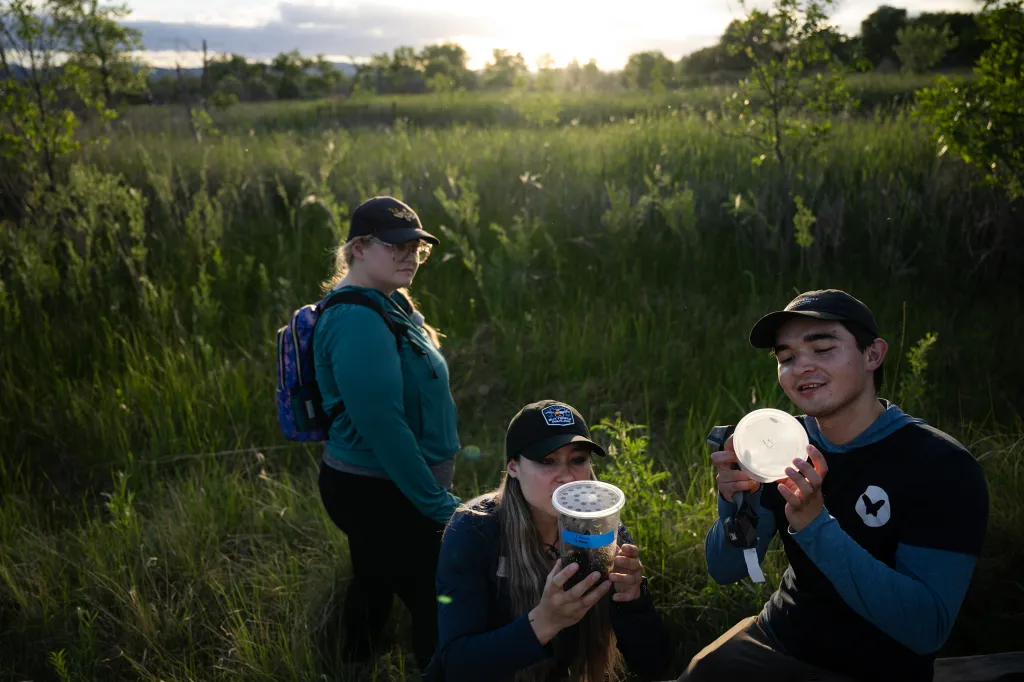
Han was one of a small group of researchers trekking through knee-high grass in Fort Collins on Wednesday night, searching for fireflies to capture as part of the Pavilion’s husbandry program. That program, which annually collects fireflies in the wild, is focused on learning under what conditions fireflies survive into adulthood and how to reintroduce lab-bred fireflies into the wild to help declining populations, said Francisco Garcia Bulle Bueno, the Pavilion’s director of research and conservation.
Fireflies, an indicator species, are like “a canary in a coal mine,” said Dr. Orit Peleg, a 42-year-old associate professor at the University of Colorado Boulder who studies Colorado fireflies. A strong population of fireflies is a sign of a healthy wetland habitat, she said.
“When they go away, because they’re such a sensitive species, then that could be a sign that there are bigger issues,” Peleg said.
The research crew on Wednesday staked claim on a section of a boardwalk meandering through the protected wetland, setting down a cooler with miniature firefly habitats before venturing out in search of the glowing insects. The goal was to leave with 10 female fireflies and 40 males, Butterfly Pavilion animal wellbeing coordinator Malaney Dodson, 28, said.
While the collection always happens in the same area, the timing has crept earlier and earlier, Dodson said. The Butterfly Pavilion schedules the fieldwork for roughly 10 days after the season’s first firefly sightings to give the insects time to emerge and start breeding. Several years ago, that happened in early July.
Bird calls and the buzz of insects filled the air as the team coaxed fireflies off plants and scooped them from the ground in clear cups — at one point even snatching one out of midair — before transferring them into the mini habitats, where they will remain undisturbed for several weeks as the fireflies mate and lay eggs.
Butterfly Pavilion scientists captured Colorado fireflies for the first time in 2021 and have done so each year since, hatching hundreds of eggs during the breeding process, Garcia Bulle Bueno said. Only five of those have grown into full adults.
“These numbers are still amazing because it means that we are able to get them to adulthood. It’s not easy,” Garcia Bulle Bueno said.
Understanding the best conditions for raising fireflies is “vital for protecting the species,” Garcia Bulle Bueno said. “Unfortunately, insects are decreasing, and this is a big concern. That’s why the Butterfly Pavilion’s work is now so important — we can support these populations, which are basically the foundation for most life on Earth.”
The glowing creatures could exist in many places across Colorado, but researchers can’t visit them all. Instead, they rely on confirmed sightings from community members and head out into the field to check for themselves, Peleg said. Researchers still aren’t sure how many kinds of fireflies live in Colorado, but her lab has identified at least three species from flash patterns and DNA testing.
Read more Mystery Potato Hovering Over Colorado Is Reported in Latest UFO Files
“Fireflies, in general, exist as flashing adults for about two weeks out of the entire year, and … only flash for a couple of hours every night,” Peleg said. “To see them, you need a really dark environment because their flashes are very dim and super easy to miss.”
Other states, where wetland habitats are more plentiful, may have dozens of different species, Peleg said.
“The firefly population in Colorado is much more rare and precious,” she said. “We’re just really trying to document it as much as we can and understand them as much as we can, while they’re still here.”
Garcia Bulle Bueno said claims that this may be the last generation to see fireflies might be a bit dramatic, but noted that populations appear to be decreasing across the globe.
Colorado scientists haven’t been able to identify any population patterns at the state level because of insufficient data, Peleg said. There aren’t enough years of research to work with, and researchers are just starting to map out the state’s firefly populations properly, she said. However, Peleg said she’s particularly concerned about fireflies in drier climates, like Colorado, because the insects are already few and far between compared to the tropics.
If the Butterfly Pavilion can crack the code to breeding fireflies in captivity by figuring out the perfect conditions to raise them under, it can create a “conservation bank,” Garcia Bulle Bueno said.
He said conservation banks already exist for various plant species — seeds are placed into protected storage and can be replanted if a plant’s wild population is lost — and wants to do the same thing for fireflies by rearing specimens in the lab that can be reintroduced to the wild if those populations decline or disappear.
Last year, his team “closed the cycle” for the first time by successfully mating a lab-reared firefly with males captured in the wild.
“Georgia was born in the lab, she bred in the lab, she laid eggs in the lab,” Garcia Bulle Bueno said. “That’s a huge milestone for the whole program.”
Get more Colorado news by signing up for our daily Your Morning Dozen email newsletter.
Read more Colorado wildlife officers kill gray wolf linked to attacks on 22 sheep