






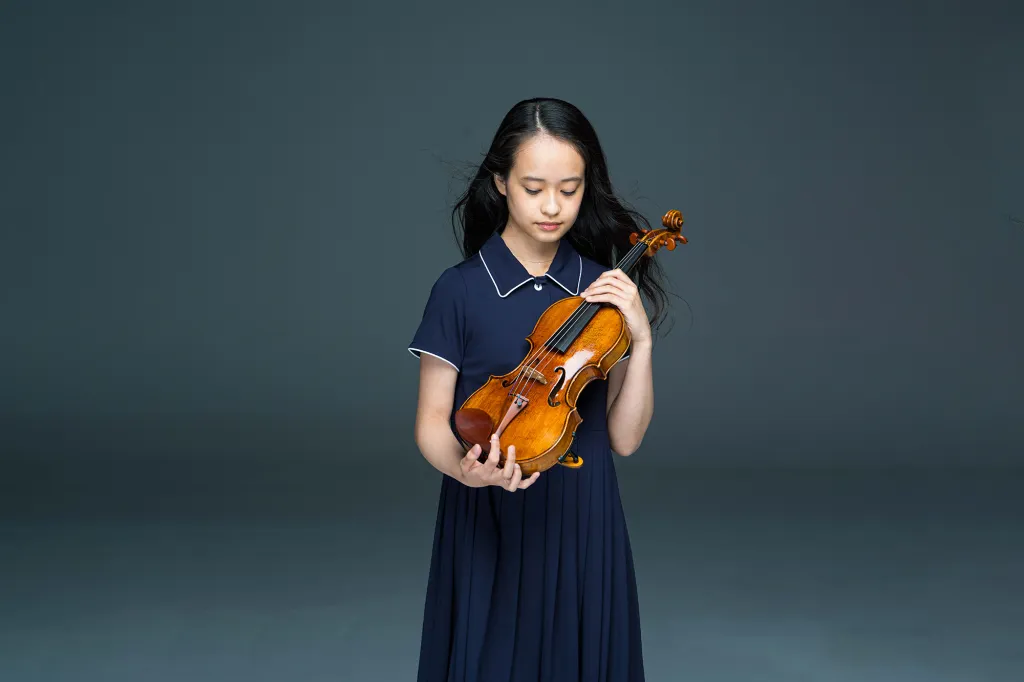
There are two very different ways to experience live music this summer. You could, potentially, shell out hundreds of dollars for a stadium nosebleed seat and spend the evening dodging stale beer spills from your inebriated neighbors while squinting at a heavily produced pop set through a pixelated video screen, all to watch a stadium headliner who isn’t even singing live. Or, for a fraction of that cost, you could sit inside a historic mountain auditorium while a teenage violin prodigy who recently debuted with the Berlin Philharmonic performs Sibelius as a full orchestra tears through Tchaikovsky.
For those opting for the latter, the Colorado Music Festival officially kicks off its landmark 50th season Thursday and Friday at Chautauqua Auditorium. The opening concerts feature 15-year-old violinist Himari performing Sibelius’ technically demanding Violin Concerto, alongside a world premiere by University of Colorado Boulder composer Carter Pann and Tchaikovsky’s heroic Symphony No. 5. Running through Aug. 9, the month-long celebration brings an expansive lineup of orchestral masterworks, chamber series and world-class guest artists to the historic stage.
The anniversary season arrives as Boulder is leaning harder into its identity as a performing arts city, with the Sundance Film Festival headed to town in 2027 and to prepare, Chautauqua Auditorium is in the middle of major upgrades aimed at making the famously rustic summer venue more usable outside its traditional warm-weather season.
Peter Oundjian, the festival’s music director, said the improvements at Chautauqua have already prompted early conversations about what else Colorado Music Festival could do there in the future, including the possibility of a winter week of programming.
“It’s possible that we could have a winter week of some kind,” Oundjian said. “It might be chamber music, but we’ve certainly started to talk about it.”
For now, though, the 50th anniversary season remains rooted in the festival’s summer identity, complete with big names, big repertoire and a conductor who seems to have a personal connection to half the lineup.
The anniversary lineup includes pianist Yuja Wang, one of classical music’s highest-profile soloists; Canadian Brass, the world-renowned brass quintet; conductor Jeffrey Kahane, a former Colorado Symphony music director who will lead Bach’s complete Brandenburg Concertos; conductor Leonard Slatkin, a major American maestro leading an all-American program; pianist Nobuyuki Tsujii, the blind Japanese virtuoso performing Rachmaninoff; Philadelphia Orchestra principal clarinetist Ricardo Morales; New Zealand-born conductor Gemma New; the Danish String Quartet; and pianist Michelle Cann, who will perform the world premiere of a new concerto by composer Valerie Coleman.
Oundjian said part of the festival’s appeal is the way it brings major artists together with the Colorado Music Festival Orchestra, a summer ensemble made up of professional musicians who travel to Boulder each year from across the country.
“A lot of it is about making music with the people we’re close to, and then, of course, making the orchestra as wonderful as it can be,” Oundjian said. “It is a great, great orchestra.”
For a festival that began in 1976, the 50-year mark lands as Boulder’s arts scene undergoes a broader shift.
“As with most festivals, they start very small, with the passion of one or two people,” Oundjian said, citing early pioneers like founder Giora Bernstein and a small circle of dedicated local music lovers. “When you think about the dream that they had and what ensued, it’s inspiring. Everything has to start with a single step.”
Oundjian, who took the helm around the festival’s 41st year, has watched the organization mature into a summer institution that pulls top-tier professional musicians from across the country into a single ensemble. For him, Boulder’s natural landscape is only half the draw for these traveling artists.
“It’s not only the mountains and the air that appeals to people when they come to Boulder or move to Boulder,” Oundjian said. “It’s also the love for the arts.”
The season is dedicated to the memory of longtime festival supporter Ralph “Chris” Christoffersen, while also arriving in a year when the festival is remembering Carol Kassoy, a board member and supporter who helped launch CMF’s family concerts.
“It’s a big year, actually, one way or another,” Oundjian said.
For veteran principal trumpet Jeffrey Work, who first joined the orchestra in 1999, the heavy programming brings the perfect amount of brass-section rigor.
“This summer is really full of celebratory blockbusters, and I think that is intentional for the 50th anniversary of the festival,” Work said.
The summit of that mountain is Mahler’s colossal Third Symphony, which Oundjian will conduct for the Aug. 9 finale.
“Mahler Three at the end of the season is a real tour de force for the trumpet, and therefore it is a lot of fun to play, a lot of pressure to play, and at the same time, just unbelievably beautiful and engaging music,” Work said. “I love Mahler. That’s probably the orchestral highlight of the summer.”
Yet Work’s most anticipated performance is a work that has never been performed in front of an audience before. On July 21, he will premiere “Love Notes,” a new chamber piece for trumpet and strings by composer James Stephenson. The work was commissioned as a surprise birthday gift by Work’s wife, May, to musically depict four forms of human love: parental, peer, partner and personal.
Read more A Colorado county’s new ‘unicorn’ home health program fills gap left by provider’s closure
Work called it the “best birthday present ever.”
According to Work, playing chamber music is a rare luxury during a summer that is physically taxing for a brass player.
“To be blunt, I am so incredibly busy using my embouchure to get through the big orchestra series that normally I don’t have the bandwidth to do chamber music at the Colorado Music Festival,” Work said.
His survival strategy for the grueling schedule is straightforward: learn the music before arriving in Colorado, hike in the Flatirons when possible and rely on colleagues who can help distribute the load. In the opening program, for instance, another trumpet player will take the Sibelius concerto, leaving Work to focus entirely on Tchaikovsky’s Fifth.
“There are ways for me to sneak rest,” Work said. “That’s because I have great colleagues and an understanding festival.”
That behind-the-scenes camaraderie is what keeps Work returning to Boulder after nearly three decades. Because the festival orchestra is a summer-only ensemble, musicians fly in from across the United States, rehearse intensely, live together and then scatter back to their winter orchestras.
Work described the atmosphere as “summer camp for grown-ups.” Many players stay in apartments near Baseline Road and Broadway, where offstage life quickly turns communal, complete with poolside barbecues and families in tow. But the ultimate anchor remains the venue itself.
“When you drive up that driveway and you see the Flatirons and this beautiful, 130-year-old building, you can’t help but feel something special is about to happen,” Work said.
That sense of occasion, however, should not scare off newcomers. Oundjian is actively trying to dismantle the persistent myth that classical music requires a secret rule book, a tuxedo or an elite background.
“First of all, I would say that it’s very informal,” Oundjian said. “Some people wonder with classical music, ‘What do I wear? I’ve got to wear a tuxedo.’ It’s very informal. We all speak from the stage. It is the least elitist experience you could imagine. If people want to clap between movements, I don’t care.”
Work similarly rejected the tired industry cliché that classical audiences are dying out.
“I have always thought that is nonsense,” Work said. “When you come to our concerts, the audiences are lively. They’re not just sitting there picking their noses. They really love being there.”
Ultimately, both the director and the musician agreed that the value of the festival in 2026 comes down to the rare modern commodity of shared, uninterrupted attention.
“I like to tell people that the Colorado Music Festival is a place they get to come where they don’t have to turn off their phones, they get to turn off their phones,” Work said. “We are all there together, and every performance is different. Every performance of the same music is even different.”
As the festival prepares to strike its first chord of the next half-century, Oundjian hopes that magic formula hits home for a new generation of listeners.
“I hope a lot of people will come for the first time to the festival, and they will go inside Chautauqua and hear the glorious sound of an all-acoustic concert with somewhere between 80 and 150 musicians,” Oundjian said. “And they’ll say, ‘My goodness, I have to come back. This is a really precious experience, and we should all, as a community, value this festival.’”
The Colorado Music Festival runs July 9 through Aug. 9 at Chautauqua Auditorium, 900 Baseline Road, Boulder. Tickets and a full schedule are available at coloradomusicfestival.org.
Get more Colorado news by signing up for our daily Your Morning Dozen email newsletter.
Read more Today in History: July 5, Hormel introduces the world to Spam