






The two major reservoirs on the Colorado River face dire outlooks that will likely spur federal officials to restrict the amount of water flowing downstream — and decrease hydropower generation — in the coming months, even after they ordered recent emergency measures.
Projections released last week by the U.S. Bureau of Reclamation show that if dry conditions persist, Lake Powell’s water level could dip below a threshold called “minimum power pool” as soon as February. That’s the level below which water can no longer flow through the reservoir’s hydropower turbines.
Without intervention, the projections say, the lake will remain below the critical elevation for the foreseeable future.
The threat of Powell hitting that threshold — 3,490 feet in elevation — has hovered above federal water managers for months as the reservoir has continued to drop to record-low levels. In April, U.S. Bureau of Reclamation leaders announced that they would send up to 1 million acre-feet of water from the upstream Flaming Gorge Reservoir to Powell and reduce the amount of water released from Powell to keep the reservoir’s level at 3,500 feet above sea level — which includes a small buffer Reclamation officials want to maintain to stay above the power pool level.
Powell’s water levels continue to drop as Colorado River leaders deal with two crises: one climatological and one political. Long-term drought fueled by climate change has shrunk the Colorado River’s flows as federal officials and water leaders in the seven basin states — including Colorado, home to its headwaters — struggle to agree on longer-term plans for the river’s management.
So far, they’ve failed to find agreement on how to divvy up the usage cuts necessary to adapt to lower flows that reduce the water supply for farmers and residents in a region that’s home to 40 million people.
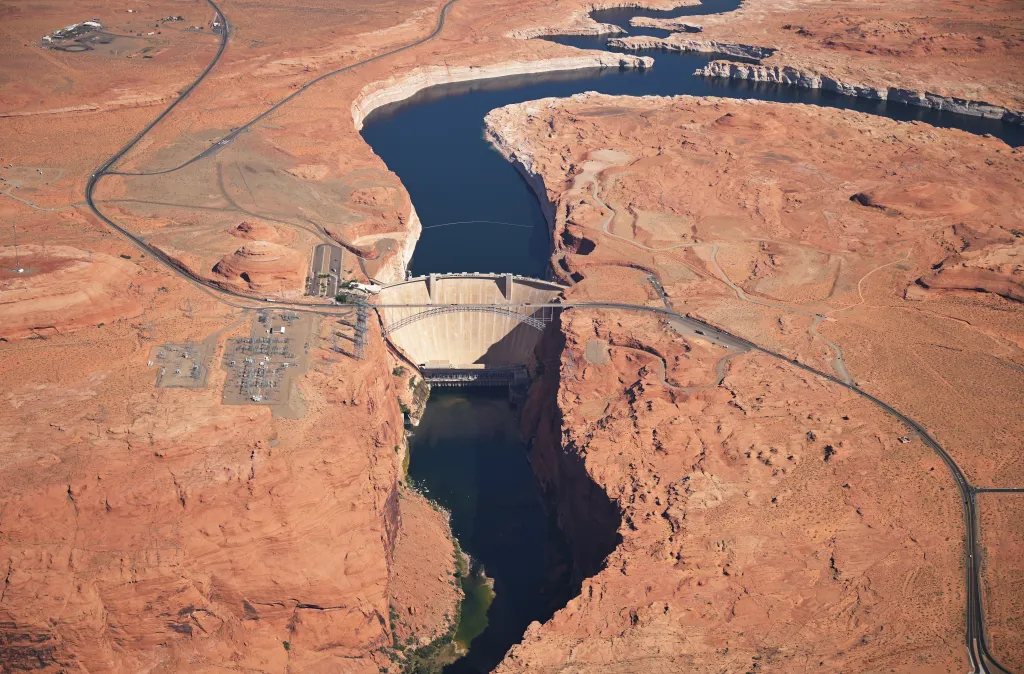
When Lake Powell’s levels fall below minimum power pool, that means water can no longer flow through the intake tubes for Glen Canyon Dam‘s hydropower facility, which is the primary method for moving water downstream from the reservoir in southern Utah.
Instead, water can move only through much smaller bypass tubes that, for years, have been considered unsafe for long-term use — though Reclamation officials now say they can be operated safely with continuous maintenance.
The bureau’s most recent projections, released Tuesday, show that the emergency measures taken this spring will only be a stopgap, unless extremely wet weather returns.
“We’re going to get to 3,500 of elevation (at Powell) this year, and we’re going to stay there for a while, unless we get snowmaggedon,” said Anne Castle, a senior fellow at the University of Colorado Law School. She previously served as the chair of the Upper Colorado River Commission and as assistant secretary for water and science at the U.S. Department of the Interior.
The updated projections come on the heels of a new analysis published this month by Castle and a slate of other Colorado River experts. It shows that a relatively dry year would crash the river’s water storage system. The two major reservoirs would then fall so low under such a scenario that they essentially would no longer be usable as water savings accounts.
Instead, water managers would be able to pass water downstream only as it flowed into the reservoirs.
“This would be an outcome with devastating consequences,” the five authors stated in the paper.
‘This cannot be allowed to happen’
Bureau of Reclamation officials have said they will operate Lake Mead and Lake Powell to keep their water levels from falling below critical elevations. The federal water managers aim to keep Powell at 3,500 feet or higher and Mead at 975 feet — water levels that allow water to continue flowing through the reservoirs’ hydropower facilities and farther downstream.
Protecting those reservoir levels means that all the water below those elevations is rendered essentially inaccessible, the study authors wrote.
“If you get to those levels and Reclamation won’t allow the reservoirs to go below those levels, it’s like those reservoirs aren’t there,” Castle said.
Those levels are coming soon, according to the analysis.
Once underwater, Colorado River canyon country reemerges as drought-stricken Lake Powell’s levels drop
Read more Today in History: June 21, first privately funded space vehicle takes flight
The study’s authors looked at two potential hydrologies: a year that is moderately wet, with water use remaining relatively unchanged; and one that is moderately dry — though not as dry as this past year — and water use falls.
A moderately wet year would buy only a few years of buffer unless the seven Colorado River basin states substantially reduce their water use, according to the analysis.
Under moderately dry conditions, Powell’s level would fall to 3,500 feet above sea level, and Mead’s would likely fall to 975 feet shortly after.
Those low reservoir levels would leave water managers with no flexibility to move water to meet the needs of water users in the Lower Basin states: Arizona, California and Nevada.
A reduction in the amount of water flowing from Powell into Mead could cause legal uncertainty across the basin, since the 1922 Colorado River compact requires the Upper Basin states — Colorado, New Mexico, Wyoming and Utah — to pass a certain amount of water downstream from Powell.
Falling reservoir levels at Lake Mead also pose a threat to hydropower capacity at Hoover Dam, which supplies power to 1.3 million people across the Southwest. According to the Bureau of Reclamation’s projections, water levels in the Nevada reservoir are projected to fall so low by November that power generation would be cut by 70%. That’s because 12 of the dam’s 17 turbines are not designed to operate at water levels below 1,035 feet.
The bureau projects that water levels in Mead will recover for a few months before plunging downward again in March — and staying below the level needed to avoid severe cuts in power production until at least April 2028, when Reclamation’s projections end.
The only way to halt the slump toward a system crash is to bring water use in line with supply, Castle said. Immediate, basinwide water cuts that are unprecedented in size are the only way to prepare for the potential of a relatively dry winter, the authors wrote in the analysis.
“The political incentives to fight for the most favorable outcomes for individual states and water users must be overcome by the necessity of preventing a Colorado River system crash, the consequences of which would be devastating for those same water users,” the analysis concludes. “This cannot be allowed to happen.”
Backup systems safe, officials say
There is a sliver of good news among the catastrophic forecasts.
If Lake Powell falls below minimum power pool, the only way to release water downstream is through four 8-foot-diameter tubes called the river outlet works. For years, Bureau of Reclamation officials have said the tubes were not designed for long-term use at low water levels, and such use could cause structural damage to the dam.
But officials now say there’s a way to safely use the river outlet works, if needed.
Recent studies of the river outlet works have shown that managers can operate the backup tubes continuously in a safe way, said Katrina Grantz, the deputy regional director for Reclamation’s Upper Colorado Region, at a conference in Boulder earlier this month. But the outlets require frequent inspections and maintenance when used continuously, which means that one of the four conduits will routinely be offline.
Over the course of a year, the maintenance rotation will result in an effective capacity of about three and a half outlets operating continuously, bureau spokesman Peter Soeth wrote in an email in response to follow-up questions from The Denver Post.
“The river outlet works were never designed to serve as the primary or long‑term release pathway,” Soeth said. “Relying on them continuously would reduce operational flexibility and, over extended periods, could introduce wear that requires more intensive maintenance.”
The bureau is studying ways to modify Glen Canyon Dam to deliver water and hydropower once the reservoir’s water level drops below minimum power pool, Soeth said.
But any changes would not help in the immediate future — the first round of design appraisals and cost estimates won’t be finished until 2027.
Read more PHOTOS: Juneteenth Music Festival and Parade in Denver on Saturday, June 20, 2026.
Get more Colorado news by signing up for our Mile High Roundup email newsletter.