







There may be no better place to test an electric vehicle than Colorado mountains.
Read more Today in History: September 20, Queen Elizabeth 2 christened in Scotland
Point it uphill and you quickly learn what sustained climbing does to battery range. Point it back downhill and regenerative braking turns gravity from adversary into ally. Throw in twisting mountain roads, elevations up to 10,000 feet and heavy weekend traffic and you have something considerably more revealing than a few laps around Denver.
So that’s exactly where I took the 2026 Hyundai IONIQ 5 Limited AWD.
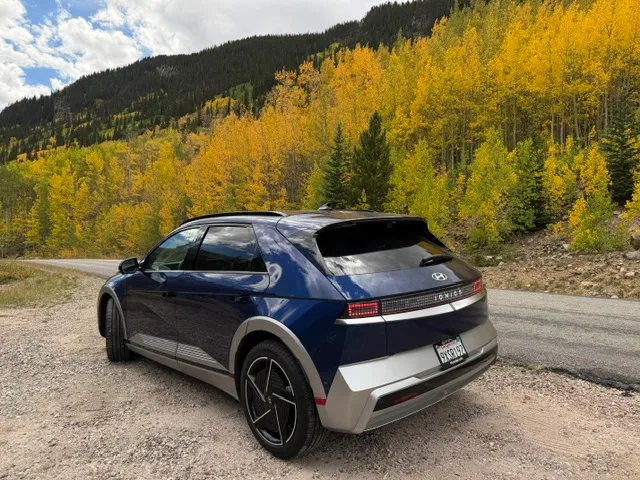
I left Denver around noon with the IONIQ 5 showing roughly 300 miles of available range. U.S. 6 led to Interstate 70 west, through Idaho Springs and on to Georgetown, where the Cosmic Blue Hyundai stopped briefly for photographs before turning south toward Guanella Pass.
The timing couldn’t have been much better.
Aspens climbing the mountainsides were exploding in yellow and gold beneath a brilliant Colorado sky punctuated by enormous white clouds. Against all that color, the dark-blue IONIQ 5 looked particularly striking.
But this wasn’t merely a sightseeing trip.
Electricity goes climbing
Guanella Pass provided a serious workout for Hyundai’s dual-motor electric drivetrain. The Limited AWD produces 320 horsepower and 446 pound-feet of torque from its two electric motors, backed by an 84-kWh lithium-ion battery.
That instant electric torque makes mountain climbing almost ridiculously effortless. There is no transmission hunting for a lower gear and no engine working harder as the air gets thinner. Press the accelerator and the Hyundai simply goes.
The IONIQ 5 felt planted and confident through the curves, while Hyundai’s HTRAC all-wheel drive provided another welcome measure of reassurance on a road where Colorado weather can change the assignment rather quickly.
Then came the other half of the EV mountain equation.
As I descended from Guanella Pass toward U.S. 285, the regenerative braking system began putting energy back into the battery. The IONIQ 5 provides steering-wheel paddles for selecting regenerative-braking levels, allowing the driver considerable control over how aggressively the vehicle slows when lifting off the accelerator.
Over the course of this mountain run, the car’s display indicated that regeneration had recovered the equivalent of about 27 miles of driving range.
That’s when regenerative braking stops being an item on a specification sheet and becomes something you can actually watch working.
Onward to 10,000 feet
Rather than turn toward Denver when I reached U.S. 285, I headed southwest for another test: Kenosha Pass.
Read more Colorado fumbles away an opportunity at Northwestern
Traffic was extraordinarily heavy, but the IONIQ 5 took it in stride. Eventually we arrived at the summit sign, which rounds the elevation to an even 10,000 feet. CDOT puts the actual elevation at 10,001 feet.
And there was another Colorado bonus along the way: a small group of bighorn sheep standing peacefully beside the roadway, seemingly as interested in passing motorists as the motorists were in them.
They weren’t particularly concerned with horsepower, battery capacity or EPA ratings.
I was.
The EPA rates this particular Limited AWD configuration at 269 miles of range, along with 108 MPGe city, 88 highway and 98 combined. Yet despite substantial mountain climbing and roughly 120 to 140 miles of driving during my outing, the Hyundai was still showing more than 140 miles of remaining range.
That’s impressive real-world performance, particularly given the terrain.
More than range
The IONIQ 5 remains one of the more visually distinctive EVs on the market. Its squared-off profile, pixel-inspired lighting and crisp geometric lines still look futuristic without becoming bizarre.
Inside, the Limited is equally convincing. My tester included heated and ventilated front seats, heated rear seats, a head-up display, Bose premium audio, surround-view monitor, panoramic fixed-glass roof and digital rearview mirror.
And when those 269 EPA-rated miles eventually disappear, the IONIQ 5’s 800-volt architecture is designed for extremely quick DC charging. Hyundai says the 84-kWh battery can go from 10% to 80% in about 20 minutes under appropriate high-power CCS charging conditions.
On this trip, however, I never needed a charger.
The IONIQ 5 still had energy to spare.
For drivers who wonder whether an electric vehicle can really handle Colorado’s high country, perhaps the answer isn’t another laboratory number.
Sometimes it’s better to point one toward the mountains and find out.
Saturday Drive Specs
Vehicle: 2026 Hyundai IONIQ 5 Limited AWD
Powertrain: Dual permanent-magnet electric motors
Drivetrain: HTRAC all-wheel drive
Battery: 84-kWh lithium-ion
Horsepower: 320hp
Torque: 446 lb-ft
EPA efficiency: 108 city / 88 highway / 98 combined MPGe
Energy consumption: 34 kWh/100 miles
Wheels: 20-inch alloy
MSRP as tested: $51,050
Email: [email protected]
Phone: 303-667-3995
The news and editorial staffs of The Denver Post had no role in this post’s preparation.