






The thousands of visitors and campers in Colorado’s Big Thompson Canyon had only minutes to find higher ground.
Around dinner time on July 31, 1976, a storm system stalled high in the sky above the center of the canyon, which stretches between Estes Park and Loveland. Over the course of an hour, the clouds unleashed more than 7 inches of rain, swelling the river encased in the narrow canyon by a foot every three minutes.
By the end of the storm the following day, the system had dumped the equivalent of the area’s normal yearly rainfall on the canyon.
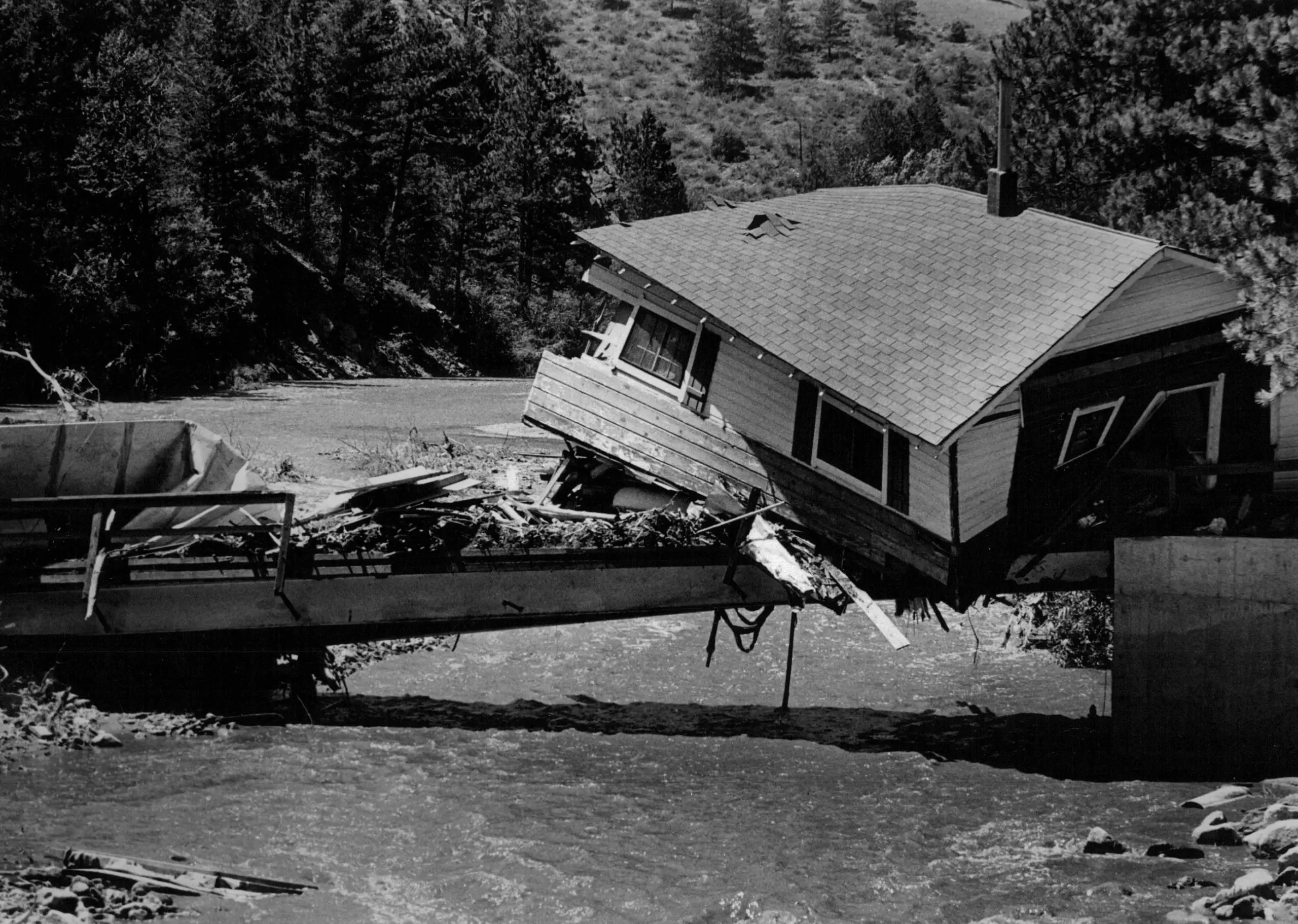
The torrent killed 144 people, injured more than 200 and stranded hundreds in the canyon, some of whom had to be rescued by helicopter. The flood destroyed more than 400 homes and 50 businesses as well as bridges, roads, power lines — nearly everything in its path. The damage totaled $234 million in today’s dollars.
Fifty years later, with the anniversary coming this Friday, the Big Thompson flood remains one of Colorado’s deadliest natural disasters. The catastrophe spurred changes to emergency response protocols and prompted deeper research into mountain floods. Larimer County officials installed warning signs in the canyon and more securely attached the canyon road to bedrock to keep it from washing away in future floods. They also banned the construction of new buildings in the floodway.
“It touched the social fabric of our community and of the nation,” Larimer County Sheriff John Feyen said.
Since the flood, technological improvements have made alerting people to flash floods easier and more effective. Weather forecasting, too, has become more accurate and specific.
While those changes make predicting and responding to a flash flood more seamless, they don’t change the whims of Mother Nature.
“Could the Big Thompson flood happen again? Of course it could,” said Bob Jarrett, a retired research hydrologist with the U.S. Geological Survey who studied the 1976 flood.
And there’s plenty of uncertainty, he added: “It could be bigger — or it could be smaller.”
Moving boulders like sand
In 1976, people in the canyon who survived the flood described hearing what sounded like a train coming at them. It was a surge of water carrying boulders, exploding propane tanks and houses.
Emergency responders used helicopters to drop sleeping bags, food and clothes to stranded survivors, as well as leaflets instructing them to gather on high ground and wait for extraction.
In the days after the flood, a National Guard helicopter deposited Jarrett in the canyon, which had become inaccessible by car. From a camp jokingly called the “Drake Hilton,” he and other researchers spent weeks in the canyon conducting a post-mortem on the floodwaters.
Jarrett and his coworkers later calculated that, at the flood’s peak, the Big Thompson River at the canyon mouth charged down at 31,200 cubic feet per second — nearly four times the previous maximum flow recorded. The torrent’s force moved boulders more than 20 feet in diameter and weighing more than 275 tons, equivalent to the heft of more than 150 Subaru Outbacks.
Smaller boulders, around 3 or 4 feet in diameter, were transported downstream like sand, he said.
To explain the river’s power, Jarrett tells people to imagine 31,200 basketballs, each measuring a little less than a cubic foot, coming toward them every second.
In some places, the river’s water rose from a foot deep to more than 20 feet in less than an hour. Standing waves reached 10 feet above the water surface.
The Big Thompson flood caused a surge in research on flash flooding in the Rocky Mountains, Jarrett said. Findings have included that flash floods are rare above 7,500 feet in elevation, but common below that altitude — like where the Big Thompson lies.
The disaster also prompted the study of ancient floods as a way to gauge how common large flash floods are in specific areas — a field called paleoflood hydrology. Jarrett later found that, in some areas of the Big Thompson River basin, the 1976 flood was the largest since the retreat of glaciers 10,000 years ago.
“We in the hydro-meteorological community, we’ve learned a lot,” he said. “But to convey that to the public is the most difficult thing to do.”
‘We’re better positioned to recover’
Dozens of static signs now instruct visitors to the Big Thompson Canyon to climb to safety in case of a flood. Electronic signs stand by to warn travelers of impending weather.
But in 1976, emergency responders had few ways to alert the thousands in the canyon of an impending storm or flood waters. Law enforcement officers drove up the canyon as flood waters rose to try to convince people to seek higher ground. Two officers — Colorado State Patrol Trooper Willis Hugh Purdy and off-duty Estes Park police officer Michael Owen Conley — drowned while helping others evacuate.
Read more Denver’s Chinatown history was erased for decades, but its preservation is newly relevant
“The whole emergency alert and notification system changed because of the Big Thompson flood,” said Lori Hodges, the director of emergency management for Larimer County.
Technological improvements have made it easier to alert people to an impending disaster. Larimer County and the National Weather Service can send an alert to cell phones across a geographic area.
“You’re holding a computer stronger than the lunar module every time you pick up your phone,” said Feyen, the sheriff.
But law enforcement will still go in person to warn people, he said, especially in areas like the canyon where cell phone service is iffy.
The 1976 flood was one in a series of disasters that prompted the creation of incident command centers — which serve as a central hub for decision-making for all agencies responding to a crisis, Hodges said. The emergency system in the 1970s was primarily focused on nuclear threats, she said, and then expanded to encompass floods, tornadoes, hurricanes and other disasters. Incident command centers are now the norm during disasters.
Many large counties have also developed their own emergency management offices in the decades since the flood. Feyen remembers when Larimer County hired its first emergency manager — that person worked alone and out of a cubicle in the sheriff’s office.
Now, Hodges commands a staff of seven. Her agency not only responds to disasters, but also tries to prevent them from happening and to reduce the risk of damage ahead of time.
In the aftermath of the 1976 flood, Feyen remembers the pundits saying a similar flood would never happen again. Then, in 2013, another stalled storm flooded Larimer and neighboring counties, causing $4 billion in damage and killing nine people.
“Our hubris tells us that this will never, ever happen again,” he said. “I never want for a minute for people to think we’ll be able to stop fires and floods and snowmageddons.”
The changes implemented in the wake of disasters, like the 1976 flood, mitigate danger and damage.
“We’re not going to stop the event, but we’re better positioned to recover,” Feyen said.
While forecasting improved, uncertainty remains
In the aftermath of the flood, found a number of factors that impacted forecasters’ ability to predict the severity of the storm and warn those in the area.
Equipment was offline. Forecasters were receiving few on-the-ground reports from the area. And the two meteorologists working that night were handling multiple incidents at once.
Weather forecasting has improved by every metric in the last 50 years, state climatologist Russ Schumacher said. Radar networks are more robust, weather forecasting models are more accurate and information is more accessible to the public.
But accurately predicting exactly how much rain will fall and where remains a challenge, he said. It is difficult to know whether a storm will drop 4 inches or 12 inches, or whether the bulk of the rain will fall directly on a narrow canyon or a few miles south.
“What happened in the Big Thompson Canyon was so localized, it was so much rain in such a small area — that’s always going to be hard to forecast,” Schumacher said.
Schumacher pointed to the deadly 2025 flash floods in central Texas as an example. Heavy rains flooded the Guadalupe River, which rose more than 25 feet in less than an hour. The surge killed 136 people, including more than 20 children at a summer camp.
It’s unclear how climate change will shape the future of flash flooding in Colorado, Schumacher said. Generally, climate change is expected to cause more extreme weather. Even if the average annual rainfall doesn’t change, the rain may fall in fewer but more intense storms.
“Even if we can’t really pin down exactly how climate change is going to affect our rainfall here, we have these awful floods in history, and we know we have the chance that they will happen again,” he said. “These are the things we know can happen, and that’s why it’s important to learn the lessons from the big floods of the past.”
Commemorations
Several organizations are hosting events this week to commemorate the 50th anniversary of the Big Thompson flood:
- The Colorado Climate Center is hosting a symposium on the science and impacts of the flood. It is set to begin at 8:30 a.m. Friday at the Estes Valley Community Center in Estes Park. Attendees can RSVP online.
- Larimer County is commemorating the anniversary and honoring the first responders and community members who were there 50 years ago. The event is set for 2-4 p.m. Friday at the Pulliam Community Building in Loveland.
- The Big Thompson Flood Memorial Inc. is hosting a commemorative event to honor those impacted by it. The event is scheduled from 4 p.m. to 7:30 p.m. Friday at the Drake Firehouse in Loveland.
- The Loveland Museum is holding an opening reception for a new exhibit that explores the history of the flood. The reception is 5-7 p.m. Friday at the Loveland Museum.
–Elise Schmelzer
Get more Colorado news by signing up for our daily Your Morning Dozen email newsletter.
Read more ‘Critically endangered’ camel Hagrid dies at Denver Zoo